
Class 9 Maths Question Paper with Solutions (Half-Yearly and Annual)
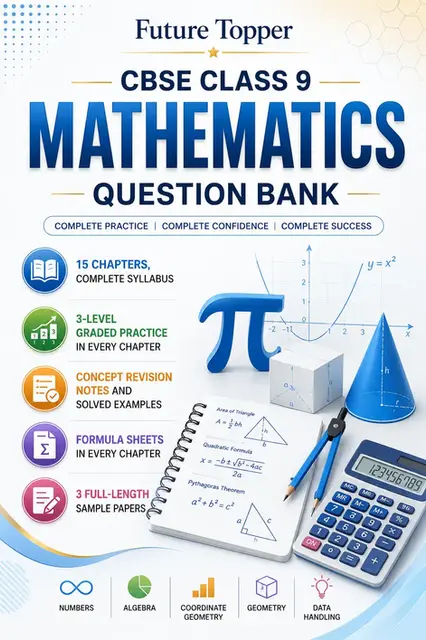
Maths is the Class 9 paper students worry about most, and it is the one that rewards practice the most. Here you will find a class 9 math half yearly paper and two annual exam papers, all written for the new NCERT book, Ganita Manjari, with every answer worked out in full.
Looking for another subject? See all Class 9 question papers.
Class 9 Maths papers
Paper | Download |
Class 9 Maths Half-Yearly Paper 1 | |
Class 9 Maths Annual Paper 1 | |
Class 9 Maths Annual Paper 2 |
What the Class 9 Maths paper looks like
Each paper is 80 marks and three hours long, with 38 questions in five sections:
Section A: 18 multiple-choice questions and 2 assertion-reason questions, 1 mark each.
Section B: 5 very short answer questions, 2 marks each.
Section C: 6 short answer questions, 3 marks each.
Section D: 4 long answer questions, 5 marks each.
Section E: 3 case studies, each worth 4 marks, with parts of 1, 1 and 2 marks.
Internal choices appear in two questions each in Sections B, C and D, and in the 2-mark part of every case study, just as in a school paper.
Maths half yearly paper
The half-yearly paper covers Ganita Manjari Part I: coordinates, linear polynomials, the world of numbers, algebraic identities, circles, perimeter and area, probability, and sequences and progressions. If you are looking for a maths question paper class 9 half yearly or a mid term question paper, this is the one to solve. It includes figures for circle and coordinate questions, because those chapters are hard to practise from text alone.
Maths annual exam papers
The two annual papers cover the full syllabus and follow CBSE's unit weightage: Number System 7 marks, Algebra 20, Coordinate Geometry 4, Geometry 25, Mensuration 14, and Statistics and Probability 10. That makes them a reliable sample paper of class 9 maths annual exam standard. They also cover the second-half chapters such as Euclid's geometry, lines and angles, congruence of triangles, quadrilaterals, surface area and volume, and statistics. Some schools still call this the SA2 exam, so if you searched for a class 9 SA2 maths question paper, these are the papers you need.
Chapters that carry the most marks
Geometry alone is worth 25 marks, almost a third of the paper, so circle theorems, congruence and quadrilaterals deserve the most practice. Algebra comes next at 20 marks: identities, factorisation, linear equations and the new chapter on sequences. Probability is newly expanded, so expect questions on empirical probability, sample spaces and simple tree diagrams.
CBSE Class 9 · 2026-27

Question banks, subject by subject
₹49a subject
BUY 2, GET 1 FREE
See Class 9 question banksHow the solutions help
Every numerical answer is worked step by step, the way an examiner wants to see it. Proofs are written out in full. For the multiple-choice questions, the solution explains why the right option is right, so you understand the idea and do not just memorise a letter. We checked every calculation before publishing.
A simple plan for the last two weeks
Solve one paper under exam conditions, then spend two days on the chapters where you lost marks. Solve the second paper and repeat. In the final days, redo only the questions you got wrong. Most students lose marks in Maths through small slips, not big gaps, so always show your working and check signs and units.
Chapters in Ganita Manjari Part I
Orienting Yourself: The Use of Coordinates. Plotting points, distance and midpoints on a grid.
Introduction to Linear Polynomials. Degree, slope and intercept, and linear growth and decay.
The World of Numbers. Rational and irrational numbers, decimal expansions and the proof that root 2 is irrational.
Exploring Algebraic Identities. Using and deriving identities, factorising quadratics and simplifying expressions.
I'm Up and Down, and Round and Round. Circles, chords and the angles they make.
Measuring Space: Perimeter and Area. Arc length, Heron's formula, sectors and Brahmagupta's formula.
The Mathematics of Maybe. Empirical and theoretical probability.
Predicting What Comes Next. Sequences, arithmetic and geometric progressions.
Common mistakes in the Class 9 Maths paper
Students often lose a mark in assertion-reason questions by choosing (a) when both statements are true but the reason does not explain the assertion. In geometry, many write the right answer but skip the reason for each step, such as "angles in the same segment" or "opposite angles of a cyclic quadrilateral", and the reason carries marks. In mensuration, forgetting to write units, or mixing up curved and total surface area, costs easy marks. Our solutions point out these traps where they come up, so you learn to avoid them before the exam.
How this Class 9 Maths question paper helps you
A Class 9 Maths question paper is the closest thing to a rehearsal of the real exam. It shows you which chapters you can solve quickly and which ones still slow you down. It also builds the habit of writing every step, which is where many students lose marks even when their final answer is right. Because our maths half yearly paper and annual papers follow the current pattern, you also get used to assertion-reason questions and case studies, which are newer and often confuse students in their first exam.
How to use the Class 9 Maths papers
Before the half-yearly exam, solve the half-yearly paper about two weeks ahead. Use the result to decide which chapters to revise again.
Before the annual exam, solve Annual Paper 1 first, fix your mistakes, and keep Annual Paper 2 for the last week as a final check.
Do the paper in one sitting of three hours. Do not look at the solutions until you finish, even for one question.
When you mark your paper, give yourself marks for each step, as the examiner would, not just for the final answer.
Keep a mistakes notebook. Write down every error with the correct method beside it, and read it the night before the exam.
If you only have a few days left, solve just Sections D and E of each paper. The long answers and case studies carry 32 of the 80 marks and show quickly whether you can apply what you know.
Frequently asked questions
Which book is used for Class 9 Maths now?
NCERT's new textbook, Ganita Manjari. Our papers are written for it.
Is the half-yearly Maths paper the same in every school?
No. Each school sets its own paper and may split chapters differently. The pattern and marks are usually the same, so check your school's half-yearly chapter list.
Are figures included in the questions?
Yes. Geometry, circle and coordinate questions come with figures, as they would in your exam.
Can I download the Maths paper as a PDF?
Yes. Each paper is a printable PDF with the solutions at the end, so you can attempt it on paper first.
How long should I spend on each section?
A useful guide is 25 minutes for Section A, 20 for B, 35 for C, 50 for D and 30 for E, leaving 20 minutes to check your work.
Are these Class 9 Maths sample question papers?
Yes. Each of the three papers is a Class 9 Maths sample question paper written on Ganita Manjari, with figures and full solutions. Use the half-yearly paper for the first-term exam and the two annual papers for the final exam.
Related free pages
- Class 9 Question Papers with Solutions (Half-Yearly and Annual)
- Class 9 Hindi Sample Paper and Question Paper with Answers
- Class 9 Science Question Paper and Sample Papers with Solutions
- Class 9 English Question Paper and Practice Papers with Answers
- Class 9 SST Question Paper, Sample Papers and Model Papers
- CBSE Class 9 Syllabus 2026-27
- CBSE Class 9 English Syllabus 2026-27
- CBSE Class 9 Social Science Syllabus 2026-27
