
CBSE Class 10 Social Science Previous Year Question Papers
CBSE's official question papers from 2015 to 2026, every set, sorted by year.
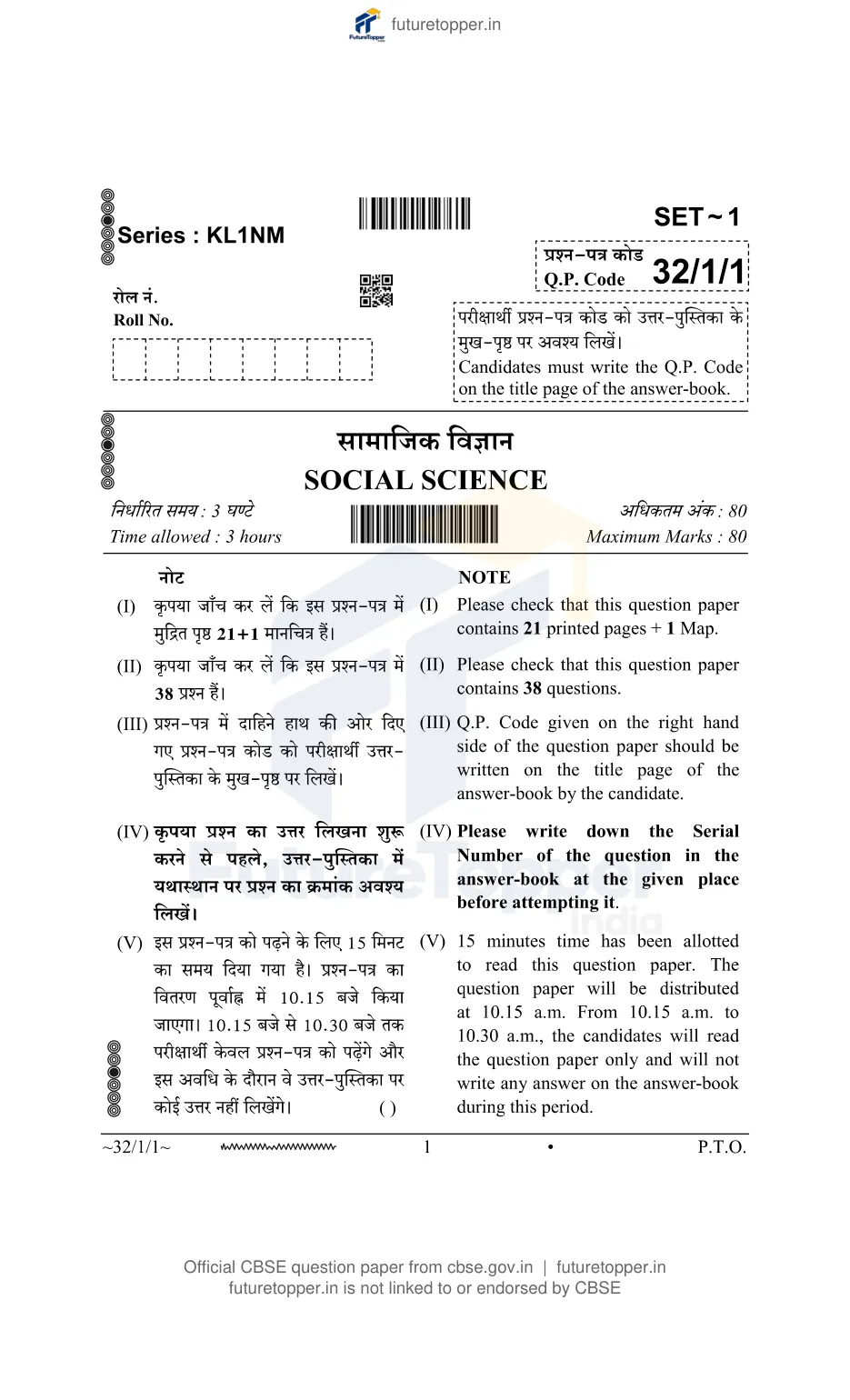
Papers from the main exam, the compartment exam and the new second board exam of 2026, with Punjabi and Urdu versions where CBSE gave them. Pick a year and open any paper in one tap: no ZIP files, no sign-up. For 2015 and 2022 to 2026, CBSE's official marking schemes give the answer to every question and the marks for each point.
Papers by year
How to read a set code: 32/1/1 is paper 32 (Social Science), group 1, set 1. The last number is the set number printed on the paper. Papers from 2015 to 2018 also have codes with two numbers, such as 32/1: paper 32, set 1. Some years also have a Punjabi version (42, for example 42/2/1) and an Urdu version (48). The 2022 compartment papers are group 6 (32/6/1). From 2023 the compartment papers have a letter in the middle: 32/C/1 in 2023, 32/S/1 in 2024 and 2025. The 2026 second board exam used groups 7 and 8 (32/7/1, 32/8/1). All sets of a year follow the same pattern.
202621 papers
Class 10 Social Science question paper 2026
Main exam
- Set 32/1/124 pages
- Set 32/1/224 pages
- Set 32/1/324 pages
- Set 32/2/127 pages
- Set 32/2/227 pages
- Set 32/2/327 pages
- Set 32/3/127 pages
- Set 32/3/227 pages
- Set 32/3/327 pages
- Set 32/4/132 pages
- Set 32/4/232 pages
- Set 32/4/332 pages
- Set 32/5/132 pages
- Set 32/5/232 pages
- Set 32/5/332 pages
Second board exam
202521 papers
Class 10 Social Science question paper 2025
Main exam
- Set 32/1/127 pages
- Set 32/1/227 pages
- Set 32/1/327 pages
- Set 32/2/127 pages
- Set 32/2/227 pages
- Set 32/2/327 pages
- Set 32/3/123 pages
- Set 32/3/223 pages
- Set 32/3/323 pages
- Set 32/4/124 pages
- Set 32/4/224 pages
- Set 32/4/324 pages
- Set 32/5/132 pages
- Set 32/5/232 pages
- Set 32/5/332 pages
- Set 32/6/132 pages
- Set 32/6/232 pages
- Set 32/6/332 pages
Compartment exam
202418 papers
Class 10 Social Science question paper 2024
Main exam
- Set 32/1/124 pages
- Set 32/1/224 pages
- Set 32/1/324 pages
- Set 32/2/132 pages
- Set 32/2/232 pages
- Set 32/2/332 pages
- Set 32/3/132 pages
- Set 32/3/232 pages
- Set 32/3/332 pages
- Set 32/4/127 pages
- Set 32/4/227 pages
- Set 32/4/327 pages
- Set 32/5/127 pages
- Set 32/5/227 pages
- Set 32/5/327 pages
Compartment exam
202327 papers
Class 10 Social Science question paper 2023
Main exam
- Set 32/1/132 pages
- Set 32/1/232 pages
- Set 32/1/332 pages
- Set 32/2/123 pages
- Set 32/2/223 pages
- Set 32/2/323 pages
- Set 32/4/124 pages
- Set 32/4/224 pages
- Set 32/4/324 pages
- Set 32/5/123 pages
- Set 32/5/223 pages
- Set 32/5/323 pages
- Set 32/6/132 pages
- Set 32/6/232 pages
- Set 32/6/332 pages
Compartment exam
Other versions (9): Punjabi, Urdu
- Set 42/2/1, Punjabi version, Main exam15 pages
- Set 42/2/2, Punjabi version, Main exam15 pages
- Set 42/2/3, Punjabi version, Main exam15 pages
- Set 48/4/1, Urdu version, Main exam16 pages
- Set 48/4/2, Urdu version, Main exam16 pages
- Set 48/4/3, Urdu version, Main exam16 pages
- Set 48/C/1, Urdu version, Compartment exam17 pages
- Set 48/C/2, Urdu version, Compartment exam17 pages
- Set 48/C/3, Urdu version, Compartment exam17 pages
202227 papers
Class 10 Social Science question paper 2022
Main exam
- Set 32/1/111 pages
- Set 32/1/211 pages
- Set 32/1/311 pages
- Set 32/2/112 pages
- Set 32/2/212 pages
- Set 32/2/312 pages
- Set 32/3/111 pages
- Set 32/3/211 pages
- Set 32/3/311 pages
- Set 32/4/112 pages
- Set 32/4/212 pages
- Set 32/4/312 pages
Compartment exam
Other versions (12): Punjabi, Urdu
- Set 42/3/1, Punjabi version, Main exam9 pages
- Set 42/3/2, Punjabi version, Main exam9 pages
- Set 42/3/3, Punjabi version, Main exam9 pages
- Set 48/2/1, Urdu version, Main exam8 pages
- Set 48/2/2, Urdu version, Main exam8 pages
- Set 48/2/3, Urdu version, Main exam8 pages
- Set 42/6/1, Punjabi version, Compartment exam7 pages
- Set 42/6/2, Punjabi version, Compartment exam7 pages
- Set 42/6/3, Punjabi version, Compartment exam7 pages
- Set 48/6/1, Urdu version, Compartment exam7 pages
- Set 48/6/2, Urdu version, Compartment exam7 pages
- Set 48/6/3, Urdu version, Compartment exam7 pages
202015 papers
Class 10 Social Science question paper 2020
Main exam
20189 papers
Class 10 Social Science question paper 2018
Main exam
201712 papers
Class 10 Social Science question paper 2017
Main exam
201615 papers
Class 10 Social Science question paper 2016
Main exam
- Set 32/1, Outside Delhi11 pages
- Set 32/1/1, Delhi11 pages
- Set 32/1/2, Delhi11 pages
- Set 32/1/3, Delhi11 pages
- Set 32/2, Outside Delhi11 pages
- Set 32/2/1, Foreign12 pages
- Set 32/2/2, Foreign12 pages
- Set 32/2/3, Foreign12 pages
- Set 32/3, Outside Delhi11 pages
Other versions (6): Punjabi
- Set 32/1/1, Delhi, map sheet, Main exam2 pages
- Set 32/1/2, Delhi, map sheet, Main exam2 pages
- Set 32/1/3, Delhi, map sheet, Main exam2 pages
- Set 42/1, Outside Delhi, Punjabi version, Main exam11 pages
- Set 42/2, Outside Delhi, Punjabi version, Main exam11 pages
- Set 42/3, Outside Delhi, Punjabi version, Main exam11 pages
20159 papers
Class 10 Social Science question paper 2015
Main exam
The 2014 and 2019 papers are not on CBSE's official website, so they are not listed here.
Official CBSE question papers, downloaded from cbse.gov.in. The questions are CBSE's, unchanged. Future Topper is not linked to or endorsed by CBSE.
Class 10 Social Science eBooks
BUY 2, GET 1 FREE
 Social Science Sample papers 2026-27₹59
 Social Science Question Bank 2026-27₹49
 Social Science Revision Capsule 2026-27Free
The Class 10 Social Science paper at a glance
38 questions, 80 marks and 3 hours, with 15 minutes before that just to read the paper. The paper has four sections, one for each book, and each section is worth 20 marks. The other 20 marks of your result come from school.
- 4 MCQs, one 2-mark, one 3-mark and one 5-mark answer, a 4-mark case study, and 2 marks of map
- 6 MCQs, one 2-mark and one 5-mark answer, a 4-mark case study, and 3 marks of map
- 4 MCQs, two 2-mark, one 3-mark and one 5-mark answer, and a 4-mark case study
- 6 MCQs, three 3-mark answers and one 5-mark answer
No overall choice, but you pick one of two options in a few questions. In the sample paper these are one 3-mark and one 5-mark question in History, the 5-mark question and part of the map in Geography, and the 5-mark questions in Political Science and Economics. Students with a visual impairment get a separate question in place of each map or picture question. This is the pattern of CBSE's 2026-27 sample paper, and the 2026 papers on this page follow it too (see our Class 10 Social Science sample papers page).
How the 80 marks split between the books
Each of the four books is exactly a quarter of the paper.
These numbers hold in the exam. We went through 8 recent papers question by question, two sets from each year, 2023 to 2026. Every book got exactly 20 marks in all 8, even in 2023 to 2025, when the paper was sorted by question type instead of by book. Inside a book, a chapter's marks change from paper to paper: Nationalism in India got 6 to 8 marks in every paper, Nationalism in Europe anywhere from 3 to 8. So no chapter is safe to skip.
- History (India and the Contemporary World II)20Nationalism in Europe, Nationalism in India, The Making of a Global World (only the pre-modern world, parts 1 to 1.3), Print Culture and the Modern World, plus map
- Geography (Contemporary India II)20Resources and Development, Forest and Wildlife, Water Resources, Agriculture, Minerals and Energy, Manufacturing Industries, Lifelines of National Economy (map only), plus map
- Political Science (Democratic Politics II)20Power-sharing, Federalism, Gender, Religion and Caste, Political Parties, Outcomes of Democracy
- Economics (Understanding Economic Development)20Development, Sectors of the Indian Economy, Money and Credit, Globalisation and the Indian Economy (only "What is globalisation" and the factors behind it)
Questions that came every year
Eight kinds of question came in all 8 of those papers.
- A map question: 2 History places to identify, then 3 Geography places to locate and label5 marks
- One of those Geography map places was a sea port or an international airport1 mark
- The 5-mark History answer on nationalism (in Europe in 6 papers, in India in 2)5 marks
- A written answer or case study on Nationalism in India (Non-Cooperation, Civil Disobedience, Quit India and others)3 to 5 marks
- A written answer on political parties: their functions, role or the multiparty system3 or 5 marks
- A written answer on outcomes of democracy2 to 5 marks
- A written answer or case study on credit: formal and informal loans, collateral, banks, the RBI, SHGs or cooperatives3 to 5 marks
- A written answer on globalisation2 to 5 marks
Three more came in 7 of the 8 papers: a Congress session place on the History map (Calcutta or Nagpur 1920, or Madras 1927), a nuclear power plant on the Geography map, and a question on local government, such as decentralisation, panchayats or the 1992 amendment. Practise the map places on CBSE's list until you can mark them fast; revise their chapters from our Class 10 Social Science notes.
Practise this year's pattern next
Past papers show what CBSE has asked before. For this year's pattern, practise with sample papers.
CBSE Class 10 Social Science Sample papers 2026-27
How to practise with these papers
Start with 2026: its papers match your exam exactly, four sections of 20 marks. Then do 2025, 2024 and 2023. They have the same question types and marks, only sorted by type. Skip their questions on what is not in this year's board exam: The Age of Industrialisation; written questions on Lifelines; The Making of a Global World after the pre-modern world (for example Bretton Woods or 19th-century migration); and Globalisation beyond what it is and what made it possible (for example the WTO or fair globalisation). Papers from 2015 to 2022 used older patterns (90 marks up to 2017, a 6-mark map in 2020, a 40-mark Term 2 paper in 2022), so use them for extra questions, not as timed tests.
Write each paper in one sitting of 3 hours, book closed, and spend the first 15 minutes only reading, as in the real exam. Keep to the word limits: 40 words for 2 marks, 60 for 3, 120 for 5.
Mark the map on a blank outline map of India every time, then check your answers with CBSE's marking scheme: in the board exam, each point earns marks.
Note the chapters where you lost marks, revise them from the Class 10 Social Science notes, then write the next paper.
Once the past papers are done, move to the Class 10 Social Science sample papers for this year's pattern. Papers for your other subjects are on the CBSE Class 10 previous year papers page.
Keep the Class 10 Social Science syllabus open while you practise, so you know what is still in the course.
Official CBSE sources
- CBSE marking schemes (answer keys), 2022 to 2026 (opens in a new tab)
- CBSE 2015 Class X question papers and marking schemes (opens in a new tab)
- CBSE curriculum 2026-27, Social Science (chapters, marks, map list, question paper design) (opens in a new tab)
- CBSE sample question paper 2026-27, Social Science (opens in a new tab)
- CBSE notification on two board exams for Class X from 2026 (opens in a new tab)
Frequently asked questions
Where can I download CBSE Class 10 Social Science previous year papers?
On this page: every paper from 2015 to 2026 opens in one tap. They are CBSE's own papers from cbse.gov.in.
Are answers available for these papers?
Yes, for 2015 and 2022 to 2026: CBSE publishes an official marking scheme with the answer to every question and the marks for each point.
Which years' papers match the 2026-27 exam pattern?
2026 exactly: 38 questions in four sections, one per book, 20 marks each, the same as the 2026-27 sample paper. The 2023 to 2025 papers have the same question types and marks (37 questions), only sorted by question type; skip their questions on chapters no longer in the board exam.
Which map places can come in the exam?
Only places on CBSE's map list for Class 10. History: the Congress sessions at Calcutta and Nagpur (1920) and Madras (1927), Kheda, Champaran, the Ahmedabad mill workers' satyagraha, Jallianwala Bagh and Dandi. Geography: soils, major dams, crop areas, mines, oil fields, power plants, industries, software parks, sea ports and international airports named in the list.
Is The Age of Industrialisation in the 2026-27 board exam?
No. CBSE's 2026-27 curriculum tests it in school (periodic assessment) only. Lifelines of National Economy comes in the board exam only as map work.
Why are there so many papers each year?
CBSE sets different papers for different groups and sets (for example 32/1/1, 32/1/2, 32/1/3), and in some years also Punjabi and Urdu versions. Papers from 2016 on also have separate questions for visually impaired candidates in place of the map and picture questions.
What is the second board exam in Class 10?
From 2026, Class 10 has two board exams. The first (from mid-February) is compulsory. The second (in May) is optional, for students who want to improve in up to 3 subjects. It is also the compartment exam: a student who fails a subject in the first exam can write that subject again in the second exam. The 2026 second exam Social Science papers are on this page.

