
CBSE Class 10 Maths Previous Year Question Papers
CBSE's official question papers from 2015 to 2026, every set, sorted by year.
Standard and Basic, from the main exam, the compartment exam and the new second board exam of 2026. Pick a year and open any paper in one tap: no ZIP files, no sign-up. For 2022 to 2026, CBSE's official marking schemes give the answer to every question and the marks for each step.
Papers by year
How to read a set code: 30/1/1 is paper 30 (Maths Standard; Basic is 430), group 1, set 1. The last number is the set number printed on the paper. Some 2015 to 2017 papers have only two numbers, such as 30/1: paper 30, set 1. CBSE marks no set as main, and from 2018 it does not say which group went to which region. All sets of a year follow the same pattern.
202637 papers
Class 10 Maths question paper 2026
Main exam: Mathematics Standard
- Set 30/1/116 pages
- Set 30/1/216 pages
- Set 30/1/316 pages
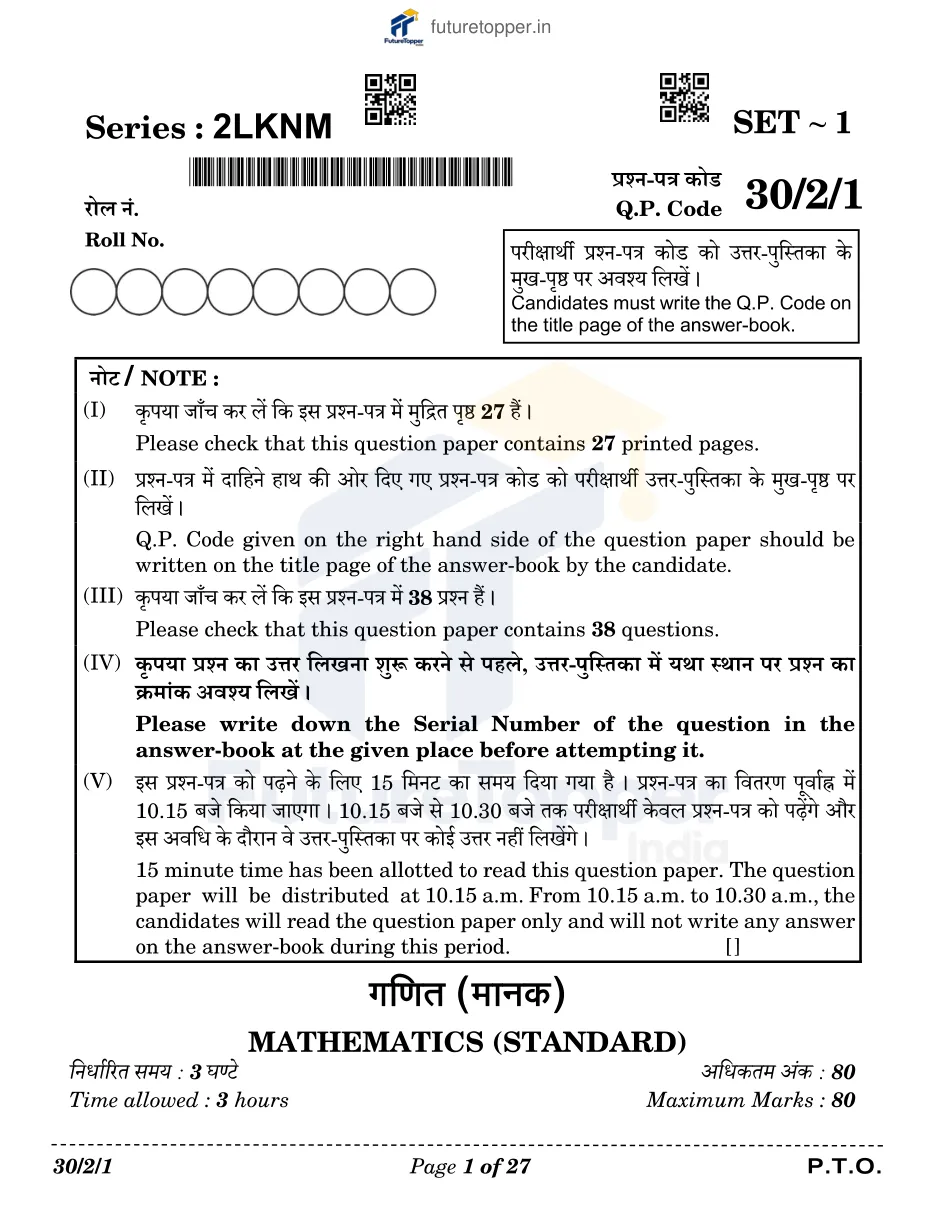
- Set 30/2/127 pages
- Set 30/2/227 pages
- Set 30/2/327 pages
- Set 30/3/127 pages
- Set 30/3/227 pages
- Set 30/3/327 pages
- Set 30/4/124 pages
- Set 30/4/224 pages
- Set 30/4/324 pages
- Set 30/5/124 pages
- Set 30/5/224 pages
- Set 30/5/324 pages
Main exam: Mathematics Basic
- Set 430/4/124 pages
- Set 430/4/224 pages
- Set 430/4/324 pages
- Set 430/5/124 pages
- Set 430/5/224 pages
- Set 430/5/324 pages
Second board exam: Mathematics Standard
- Set 30/7/127 pages
- Set 30/7/227 pages
- Set 30/7/327 pages
- Set 30/8/132 pages
- Set 30/8/232 pages
- Set 30/8/332 pages
Second board exam: Mathematics Basic
- Set 430/7/127 pages
- Set 430/7/227 pages
- Set 430/7/327 pages
- Set 430/8/124 pages
- Set 430/8/224 pages
- Set 430/8/324 pages
Other versions (4): for visually impaired candidates
202546 papers
Class 10 Maths question paper 2025
Main exam: Mathematics Standard
- Set 30/1/127 pages
- Set 30/1/227 pages
- Set 30/1/327 pages
- Set 30/2/127 pages
- Set 30/2/227 pages
- Set 30/2/327 pages
- Set 30/3/123 pages
- Set 30/3/223 pages
- Set 30/3/323 pages
- Set 30/4/116 pages
- Set 30/4/216 pages
- Set 30/4/316 pages
- Set 30/5/124 pages
- Set 30/5/224 pages
- Set 30/5/324 pages
- Set 30/6/124 pages
- Set 30/6/224 pages
- Set 30/6/324 pages
Main exam: Mathematics Basic
- Set 430/1/127 pages
- Set 430/1/227 pages
- Set 430/1/327 pages
- Set 430/2/123 pages
- Set 430/2/223 pages
- Set 430/2/323 pages
- Set 430/3/127 pages
- Set 430/3/227 pages
- Set 430/3/327 pages
- Set 430/4/116 pages
- Set 430/4/216 pages
- Set 430/4/316 pages
- Set 430/5/124 pages
- Set 430/5/224 pages
- Set 430/5/324 pages
- Set 430/6/124 pages
- Set 430/6/224 pages
- Set 430/6/324 pages
Compartment exam: Mathematics Standard
Compartment exam: Mathematics Basic
Other versions (4): for visually impaired candidates
202439 papers
Class 10 Maths question paper 2024
Main exam: Mathematics Standard
- Set 30/1/116 pages
- Set 30/1/216 pages
- Set 30/1/316 pages
- Set 30/2/124 pages
- Set 30/2/224 pages
- Set 30/2/324 pages
- Set 30/3/124 pages
- Set 30/3/224 pages
- Set 30/3/324 pages
- Set 30/4/123 pages
- Set 30/4/223 pages
- Set 30/4/323 pages
- Set 30/5/123 pages
- Set 30/5/223 pages
- Set 30/5/323 pages
Main exam: Mathematics Basic
- Set 430/1/216 pages
- Set 430/1/316 pages
- Set 430/2/124 pages
- Set 430/2/224 pages
- Set 430/2/324 pages
- Set 430/3/124 pages
- Set 430/3/224 pages
- Set 430/3/324 pages
- Set 430/4/123 pages
- Set 430/4/223 pages
- Set 430/4/323 pages
- Set 430/5/123 pages
- Set 430/5/223 pages
- Set 430/5/323 pages
Compartment exam: Mathematics Standard
Compartment exam: Mathematics Basic
Other versions (4): for visually impaired candidates
202356 papers
Class 10 Maths question paper 2023
Main exam: Mathematics Standard
- Set 30/1/124 pages
- Set 30/1/224 pages
- Set 30/1/324 pages
- Set 30/2/123 pages
- Set 30/2/223 pages
- Set 30/2/323 pages
- Set 30/4/116 pages
- Set 30/4/216 pages
- Set 30/4/316 pages
- Set 30/5/127 pages
- Set 30/5/227 pages
- Set 30/5/327 pages
- Set 30/6/124 pages
- Set 30/6/224 pages
- Set 30/6/324 pages
Main exam: Mathematics Basic
- Set 430/1/124 pages
- Set 430/1/224 pages
- Set 430/1/324 pages
- Set 430/2/127 pages
- Set 430/2/227 pages
- Set 430/2/327 pages
- Set 430/4/116 pages
- Set 430/4/216 pages
- Set 430/4/316 pages
- Set 430/5/123 pages
- Set 430/5/223 pages
- Set 430/5/323 pages
- Set 430/6/124 pages
- Set 430/6/224 pages
- Set 430/6/324 pages
Compartment exam: Mathematics Standard
Compartment exam: Mathematics Basic
Other versions (20): Punjabi, Urdu, for visually impaired candidates
- Set 30/B, Punjabi version, for visually impaired candidates, Main exam, Standard15 pages
- Set 30/B/5, for visually impaired candidates, Main exam, Standard23 pages
- Set 40/2/1, Punjabi version, Main exam, Standard15 pages
- Set 40/2/2, Punjabi version, Main exam, Standard15 pages
- Set 40/2/3, Punjabi version, Main exam, Standard15 pages
- Set 46/4/1, Urdu version, Main exam, Standard16 pages
- Set 46/4/2, Urdu version, Main exam, Standard16 pages
- Set 46/4/3, Urdu version, Main exam, Standard16 pages
- Set 46/B, Urdu version, for visually impaired candidates, Main exam, Standard16 pages
- Set 430/B, for visually impaired candidates, Main exam, Basic23 pages
- Set 440/2/1, Punjabi version, Main exam, Basic15 pages
- Set 440/2/2, Punjabi version, Main exam, Basic15 pages
- Set 440/2/3, Punjabi version, Main exam, Basic15 pages
- Set 440/B, Punjabi version, for visually impaired candidates, Main exam, Basic15 pages
- Set 446/4/1, Urdu version, Main exam, Basic16 pages
- Set 446/4/2, Urdu version, Main exam, Basic16 pages
- Set 446/4/3, Urdu version, Main exam, Basic16 pages
- Set 446/B, Urdu version, for visually impaired candidates, Main exam, Basic16 pages
- Set 30/C/B, for visually impaired candidates, Compartment exam, Standard23 pages
- Set 430/C/B, for visually impaired candidates, Compartment exam, Basic23 pages
202258 papers
Class 10 Maths question paper 2022
Main exam: Mathematics Standard
- Set 30/1/111 pages
- Set 30/1/211 pages
- Set 30/1/311 pages
- Set 30/2/116 pages
- Set 30/2/216 pages
- Set 30/2/316 pages
- Set 30/3/111 pages
- Set 30/3/211 pages
- Set 30/3/311 pages
- Set 30/4/112 pages
- Set 30/4/212 pages
- Set 30/4/312 pages
Main exam: Mathematics Basic
- Set 430/1/111 pages
- Set 430/1/211 pages
- Set 430/1/311 pages
- Set 430/2/112 pages
- Set 430/2/212 pages
- Set 430/2/312 pages
- Set 430/3/111 pages
- Set 430/3/211 pages
- Set 430/3/311 pages
- Set 430/4/112 pages
- Set 430/4/212 pages
- Set 430/4/312 pages
Compartment exam: Mathematics Standard
Compartment exam: Mathematics Basic
Other versions (28): Punjabi, Urdu, for visually impaired candidates
- Set 30/B/5, for visually impaired candidates, Main exam, Standard11 pages
- Set 40/3/1, Punjabi version, Main exam, Standard7 pages
- Set 40/B/5, Punjabi version, for visually impaired candidates, Main exam, Standard7 pages
- Set 46/2/1, Urdu version, Main exam, Standard8 pages
- Set 46/2/2, Urdu version, Main exam, Standard8 pages
- Set 46/2/3, Urdu version, Main exam, Standard8 pages
- Set 430/B/5, for visually impaired candidates, Main exam, Basic11 pages
- Set 446/2/1, Urdu version, Main exam, Basic8 pages
- Set 446/2/2, Urdu version, Main exam, Basic8 pages
- Set 446/2/3, Urdu version, Main exam, Basic8 pages
- Set 30/B/6, for visually impaired candidates, Compartment exam, Standard11 pages
- Set 40/6/1, Punjabi version, Compartment exam, Standard7 pages
- Set 40/6/2, Punjabi version, Compartment exam, Standard7 pages
- Set 40/6/3, Punjabi version, Compartment exam, Standard7 pages
- Set 40/B/6, Punjabi version, for visually impaired candidates, Compartment exam, Standard7 pages
- Set 46/6/1, Urdu version, Compartment exam, Standard7 pages
- Set 46/6/2, Urdu version, Compartment exam, Standard7 pages
- Set 46/6/3, Urdu version, Compartment exam, Standard7 pages
- Set 46/B/6, Urdu version, for visually impaired candidates, Compartment exam, Standard7 pages
- Set 430/B/6, for visually impaired candidates, Compartment exam, Basic11 pages
- Set 440/6/1, Punjabi version, Compartment exam, Basic7 pages
- Set 440/6/2, Punjabi version, Compartment exam, Basic7 pages
- Set 440/6/3, Punjabi version, Compartment exam, Basic7 pages
- Set 440/B/6, Punjabi version, for visually impaired candidates, Compartment exam, Basic7 pages
- Set 446/6/1, Urdu version, Compartment exam, Basic7 pages
- Set 446/6/2, Urdu version, Compartment exam, Basic7 pages
- Set 446/6/3, Urdu version, Compartment exam, Basic7 pages
- Set 446/B/6, Urdu version, for visually impaired candidates, Compartment exam, Basic7 pages
202032 papers
Class 10 Maths question paper 2020
Main exam: Mathematics Standard
- Set 30/1/115 pages
- Set 30/1/215 pages
- Set 30/1/315 pages
- Set 30/2/116 pages
- Set 30/2/216 pages
- Set 30/2/316 pages
- Set 30/3/116 pages
- Set 30/3/216 pages
- Set 30/3/316 pages
- Set 30/4/123 pages
- Set 30/4/223 pages
- Set 30/4/323 pages
- Set 30/5/123 pages
- Set 30/5/223 pages
- Set 30/5/323 pages
Main exam: Mathematics Basic
- Set 430/1/115 pages
- Set 430/1/215 pages
- Set 430/1/315 pages
- Set 430/2/116 pages
- Set 430/2/216 pages
- Set 430/2/316 pages
- Set 430/3/116 pages
- Set 430/3/216 pages
- Set 430/3/316 pages
- Set 430/4/119 pages
- Set 430/4/219 pages
- Set 430/4/319 pages
- Set 430/5/119 pages
- Set 430/5/219 pages
- Set 430/5/319 pages
Other versions (2): for visually impaired candidates
201812 papers
Class 10 Maths question paper 2018
Main exam
Other versions (9): Punjabi, Urdu, for visually impaired candidates
- Set 30/B, for visually impaired candidates, Main exam12 pages
- Set 40/1, Punjabi version, Main exam8 pages
- Set 40/2, Punjabi version, Main exam8 pages
- Set 40/3, Punjabi version, Main exam8 pages
- Set 40/B, Punjabi version, for visually impaired candidates, Main exam8 pages
- Set 46/1, Urdu version, Main exam8 pages
- Set 46/2, Urdu version, Main exam8 pages
- Set 46/3, Urdu version, Main exam8 pages
- Set 46/B, Urdu version, for visually impaired candidates, Main exam12 pages
201718 papers
Class 10 Maths question paper 2017
Main exam
- Set 30/1, Outside Delhi11 pages
- Set 30/1/1, Delhi12 pages
- Set 30/1/2, Delhi12 pages
- Set 30/1/3, Delhi12 pages
- Set 30/2, Outside Delhi11 pages
- Set 30/2/1, Foreign11 pages
- Set 30/2/2, Foreign11 pages
- Set 30/2/3, Foreign11 pages
- Set 30/3, Outside Delhi11 pages
Other versions (9): Punjabi, Urdu, for visually impaired candidates
- Set 30/B, Outside Delhi, for visually impaired candidates, Main exam11 pages
- Set 40, Outside Delhi, Punjabi version, for visually impaired candidates, Main exam8 pages
- Set 40/1, Outside Delhi, Punjabi version, Main exam8 pages
- Set 40/2, Outside Delhi, Punjabi version, Main exam8 pages
- Set 40/3, Outside Delhi, Punjabi version, Main exam8 pages
- Set 46, Outside Delhi, Urdu version, for visually impaired candidates, Main exam11 pages
- Set 46/1/1, Delhi, Urdu version, Main exam7 pages
- Set 46/1/2, Delhi, Urdu version, Main exam7 pages
- Set 46/4/3, Delhi, Urdu version, Main exam7 pages
201614 papers
Class 10 Maths question paper 2016
Main exam
- Set 30/1, Outside Delhi15 pages
- Set 30/1/1, Delhi16 pages
- Set 30/1/2, Delhi16 pages
- Set 30/1/3, Delhi16 pages
- Set 30/2, Outside Delhi15 pages
- Set 30/2/1, Foreign12 pages
- Set 30/2/2, Foreign12 pages
- Set 30/2/3, Foreign12 pages
- Set 30/3, Outside Delhi15 pages
Other versions (5): Punjabi, for visually impaired candidates
- Set 30/B, Outside Delhi, for visually impaired candidates, Main exam11 pages
- Set 40/1, Outside Delhi, Punjabi version, Main exam8 pages
- Set 40/2, Outside Delhi, Punjabi version, Main exam8 pages
- Set 40/3, Outside Delhi, Punjabi version, Main exam8 pages
- Set 40/B, Outside Delhi, Punjabi version, for visually impaired candidates, Main exam7 pages
201510 papers
Class 10 Maths question paper 2015
Main exam
- Set 30/111 pages
- Set 30/1/115 pages
- Set 30/1/215 pages
- Set 30/1/315 pages
- Set 30/211 pages
- Set 30/2/112 pages
- Set 30/2/212 pages
- Set 30/2/312 pages
- Set 30/311 pages
Other versions (1): for visually impaired candidates
The 2014 and 2019 papers are not on CBSE's official website, so they are not listed here.
Official CBSE question papers, downloaded from cbse.gov.in. The questions are CBSE's, unchanged. Future Topper is not linked to or endorsed by CBSE.
Class 10 Maths eBooks
BUY 2, GET 1 FREE
 Mathematics Sample Papers 2026-27₹59
 Mathematics Question Bank 2026-27₹49
 Maths Revision Capsule 2026-27Free
The Class 10 Maths paper at a glance
Since 2023 the paper has kept one shape: 38 questions, 80 marks and 3 hours, with 15 minutes before that just to read it. Standard and Basic have the same sections; Basic asks easier questions. Calculators are not allowed, and the other 20 marks of your result come from school.
- 18 MCQs and 2 assertion-reason questions, 1 mark each
- 5 very short answers, 2 marks each
- 6 short answers, 3 marks each
- 4 long answers, 5 marks each
- 3 case studies, 4 marks each
No overall choice, but you pick one of two options in 2 questions each of Sections B, C and D, and in the 2-mark part of each case study. This is the pattern of CBSE's 2026-27 sample paper (see our Class 10 Maths sample papers page), and the 2023 to 2026 papers follow it too.
Which chapters carry the most marks
Algebra is a quarter of the paper.
These numbers hold in the exam. We went through 8 recent papers question by question, one Standard and one Basic set from each year, 2023 to 2026. Real Numbers and Coordinate Geometry got exactly 6 marks in every paper, and Triangles between 7 and 9. So no chapter is safe to skip.
- Algebra20Polynomials, Linear Equations, Quadratic Equations, Arithmetic Progressions
- Geometry15Triangles, Circles
- Trigonometry12Trigonometric ratios and identities, Heights and Distances
- Statistics and Probability11Statistics, Probability
- Mensuration10Areas Related to Circles, Surface Areas and Volumes
- Number Systems6Real Numbers
- Coordinate Geometry6Coordinate Geometry
Questions that came every year
Seven kinds of question came in all 8 of those papers.
- Prove that a number is irrational2 or 3 marks
- Prove a trigonometric identity3 marks
- A heights and distances problem4 or 5 marks
- Mean, median or mode of grouped data4 or 5 marks
- An arithmetic progression: the nth term or the sum4 or 5 marks
- A word problem that turns into a quadratic equation4 or 5 marks
- Similar triangles2 marks
Three more came in most of them: a 3-mark proof about tangents to a circle (7 of 8 papers), the area of a sector or segment (6 of 8), and the proof of the Basic Proportionality Theorem (5 of 8). Practise these until you can write them quickly; revise their chapters from our Class 10 Maths notes.
Practise this year's pattern next
Past papers show what CBSE has asked before. For this year's pattern, practise with sample papers.
CBSE Class 10 Mathematics Sample Papers 2026-27
Standard or Basic?
Both courses study the same syllabus and have the same internal assessment; only the board paper differs. CBSE made Standard for students who want Mathematics in Class 11, and Basic for those who don't (circular Acad-03/2019).
Choosing Basic does not close the door on Maths. Since CBSE's circular of 27 May 2025, Basic students may take Mathematics in Class 11 if their school head is satisfied they can manage it. Practise your own course's papers first; Basic students who find them easy can then try a few Standard papers.
- 46%
- of the Standard paper's marks are for harder questions, where you apply or analyse
- 25%
- of the Basic paper's marks are for such questions; the other 75% test remembering and understanding
How to practise with these papers
Start with 2026, 2025, 2024 and 2023: they match your exam exactly. Papers from 2015 to 2022 used older patterns (90 marks up to 2017, a 40-mark Term 2 paper in 2022), so use them for extra questions, not as timed tests.
Write each paper in one sitting of 3 hours, book closed, and spend the first 15 minutes only reading, as in the real exam.
Check your answers with CBSE's marking scheme, step by step: in the board exam, each step earns marks.
Note the chapters where you lost marks, revise them from the Class 10 Maths notes, then write the next paper.
Once the past papers are done, move to the Class 10 Maths sample papers for this year's pattern. Papers for your other subjects are on the CBSE Class 10 previous year papers page.
Keep the Class 10 Maths syllabus open while you practise, so you know what is still in the course.
Official CBSE sources
- CBSE marking schemes (answer keys), 2022 to 2026 (opens in a new tab)
- CBSE curriculum 2026-27, Mathematics (units, marks, question paper design) (opens in a new tab)
- CBSE sample question paper 2026-27, Mathematics Standard (opens in a new tab)
- CBSE circular Acad-03/2019 (Mathematics Standard and Basic) (opens in a new tab)
- CBSE circular of 27 May 2025 (Basic students taking Mathematics in Class 11) (opens in a new tab)
Frequently asked questions
Where can I download CBSE Class 10 Maths previous year papers?
On this page: every paper from 2015 to 2026 opens in one tap. They are CBSE's own papers from cbse.gov.in.
Are answers available for these papers?
Yes, for 2015 and 2022 to 2026: CBSE publishes an official marking scheme with the answer to every question and the marks for each step.
Should I practise Standard or Basic papers?
Your own course first: your school registers you for Standard or Basic. Both are 80 marks, 3 hours and 38 questions.
Which years' papers match the 2026-27 exam pattern?
2023 to 2026: 38 questions in 5 sections for 80 marks, the same as the 2026-27 sample paper.
Can I take Maths in Class 11 if I choose Basic?
Yes, at present. CBSE's circular of 27 May 2025 allows Basic students to take Mathematics (041) in Class 11 if the school head is satisfied with their ability.
Why are there so many papers each year?
CBSE sets different papers for different regions and sets (for example 30/1/1, 30/1/2, 30/1/3), plus Punjabi and Urdu versions and papers for visually impaired candidates.
What is the second board exam in Class 10?
From 2026, Class 10 has two board exams. The first (from mid-February) is compulsory. The second (in May) is optional, for students who want to improve in up to 3 subjects. It is also the compartment exam: a student who fails a subject in the first exam can write that subject again in the second exam. The 2026 second exam Maths papers are on this page.
Are 2019 papers available?
No. 2019 papers are not on CBSE's official website, so they are not listed.

