
CBSE Class 12 Chemistry Previous Year Question Papers
CBSE's official Chemistry question papers from 2016 to 2026, every set on CBSE's website, sorted by year.
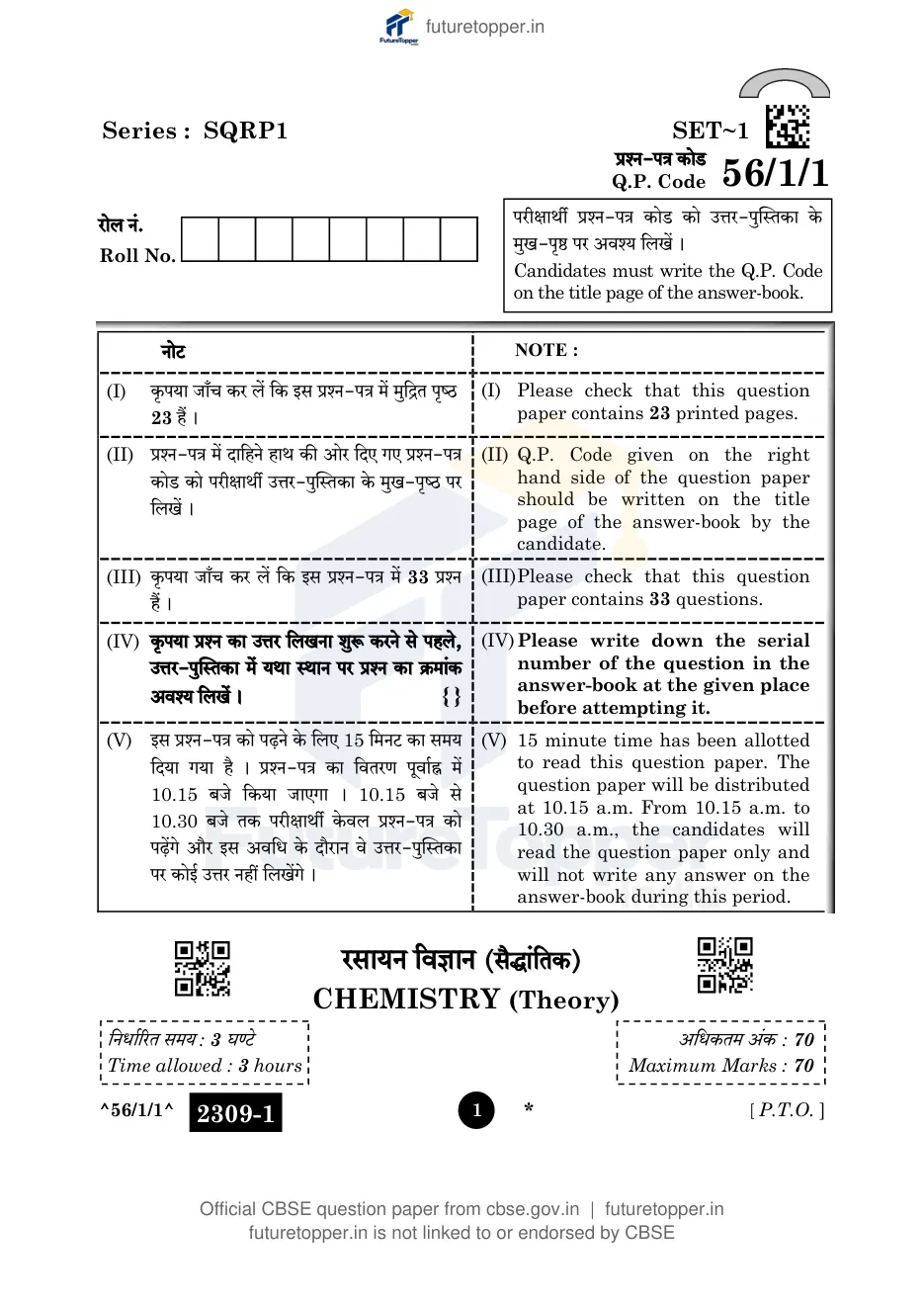
Papers from the main exam and the compartment exam, set by set. Pick a year and open any paper in one tap: no ZIP files, no sign-up. CBSE has published a marking scheme for 2016, 2017, 2018, 2020 and 2022 to 2026, and for the compartment exams of 2022 to 2026, with the answers and the marks for each step.
Papers by year
How to read a set code: 56/1/1 is Chemistry paper 56, group 1, set 1. Older and compartment papers use other groups or letters. Every set of a year follows the same pattern, so practise any one.
202620 papers
Class 12 Chemistry question paper 2026
Main exam
- Set 56/1/124 pages
- Set 56/1/224 pages
- Set 56/1/324 pages
- Set 56/2/124 pages
- Set 56/2/224 pages
- Set 56/2/324 pages
- Set 56/3/119 pages
- Set 56/3/219 pages
- Set 56/3/319 pages
- Set 56/4/123 pages
- Set 56/4/223 pages
- Set 56/4/323 pages
- Set 56/5/123 pages
- Set 56/5/223 pages
- Set 56/5/323 pages
Compartment exam
Other versions (2): for visually impaired candidates
202523 papers
Class 12 Chemistry question paper 2025
Main exam
- Set 56/1/124 pages
- Set 56/1/224 pages
- Set 56/1/324 pages
- Set 56/2/124 pages
- Set 56/2/224 pages
- Set 56/2/324 pages
- Set 56/4/123 pages
- Set 56/4/223 pages
- Set 56/4/323 pages
- Set 56/5/123 pages
- Set 56/5/223 pages
- Set 56/5/323 pages
- Set 56/6/123 pages
- Set 56/6/223 pages
- Set 56/6/323 pages
- Set 56/7/123 pages
- Set 56/7/223 pages
- Set 56/7/323 pages
Compartment exam
Other versions (2): for visually impaired candidates
202420 papers
Class 12 Chemistry question paper 2024
Main exam
- Set 56/1/127 pages
- Set 56/1/227 pages
- Set 56/1/327 pages
- Set 56/2/127 pages
- Set 56/2/227 pages
- Set 56/2/327 pages
- Set 56/3/127 pages
- Set 56/3/227 pages
- Set 56/3/327 pages
- Set 56/4/124 pages
- Set 56/4/224 pages
- Set 56/4/324 pages
- Set 56/5/124 pages
- Set 56/5/224 pages
- Set 56/5/324 pages
Compartment exam
Other versions (2): for visually impaired candidates
202320 papers
Class 12 Chemistry question paper 2023
Main exam
- Set 56/1/119 pages
- Set 56/1/219 pages
- Set 56/1/319 pages
- Set 56/2/124 pages
- Set 56/2/224 pages
- Set 56/2/324 pages
- Set 56/3/123 pages
- Set 56/3/223 pages
- Set 56/3/323 pages
- Set 56/4/123 pages
- Set 56/4/223 pages
- Set 56/4/323 pages
- Set 56/5/124 pages
- Set 56/5/224 pages
- Set 56/5/324 pages
Compartment exam
Other versions (2): for visually impaired candidates
202220 papers
Class 12 Chemistry question paper 2022
Main exam
- Set 56/1/112 pages
- Set 56/1/212 pages
- Set 56/1/312 pages
- Set 56/2/111 pages
- Set 56/2/211 pages
- Set 56/2/311 pages
- Set 56/3/112 pages
- Set 56/3/212 pages
- Set 56/3/312 pages
- Set 56/4/111 pages
- Set 56/4/211 pages
- Set 56/4/311 pages
- Set 56/5/112 pages
- Set 56/5/212 pages
- Set 56/5/312 pages
Compartment exam
Other versions (2): for visually impaired candidates
202016 papers
Class 12 Chemistry question paper 2020
Main exam
- Set 56/1/119 pages
- Set 56/1/219 pages
- Set 56/1/319 pages
- Set 56/2/119 pages
- Set 56/2/219 pages
- Set 56/2/319 pages
- Set 56/3/119 pages
- Set 56/3/219 pages
- Set 56/3/319 pages
- Set 56/4/116 pages
- Set 56/4/216 pages
- Set 56/4/316 pages
- Set 56/5/116 pages
- Set 56/5/216 pages
- Set 56/5/316 pages
Other versions (1): for visually impaired candidates
20184 papers
Class 12 Chemistry question paper 2018
Main exam
Other versions (1): for visually impaired candidates
201710 papers
Class 12 Chemistry question paper 2017
Main exam
- Set 56/1, Outside Delhi15 pages
- Set 56/1/1, Delhi12 pages
- Set 56/1/2, Delhi12 pages
- Set 56/1/3, Delhi12 pages
- Set 56/2, Outside Delhi15 pages
- Set 56/2/1, Foreign15 pages
- Set 56/2/2, Foreign15 pages
- Set 56/2/3, Foreign15 pages
- Set 56/3, Outside Delhi15 pages
Other versions (1): for visually impaired candidates
201619 papers
Class 12 Chemistry question paper 2016
Main exam
- Set 56/1/1/D, Delhi12 pages
- Set 56/1/2/D, Delhi12 pages
- Set 56/1/3/D, Delhi12 pages
- Set 56/1/C, Outside Delhi16 pages
- Set 56/1/E, Outside Delhi15 pages
- Set 56/1/N, Outside Delhi15 pages
- Set 56/1/S, Outside Delhi16 pages
- Set 56/2/1/F, Foreign12 pages
- Set 56/2/2/F, Foreign12 pages
- Set 56/2/3/F, Foreign12 pages
- Set 56/2/C, Outside Delhi16 pages
- Set 56/2/E, Outside Delhi15 pages
- Set 56/2/N, Outside Delhi15 pages
- Set 56/2/S, Outside Delhi16 pages
- Set 56/3/C, Outside Delhi16 pages
- Set 56/3/E, Outside Delhi15 pages
- Set 56/3/N, Outside Delhi15 pages
- Set 56/3/S, Outside Delhi16 pages
Other versions (1): for visually impaired candidates
CBSE's 2015 question paper page has only some subjects, and Chemistry is not one of them. CBSE's website has no Chemistry papers for 2019 and 2021.
Official CBSE question papers, downloaded from cbse.gov.in. The questions are CBSE's, unchanged. Future Topper is not linked to or endorsed by CBSE.
Class 12 Chemistry eBooks
BUY 2, GET 1 FREE
 Chemistry Sample Papers 2026-27₹69
 Chemistry Question Bank 2026-27₹49
 Chemistry Revision Capsule 2026-27Free
The Class 12 Chemistry paper at a glance
33 questions, 70 marks and 3 hours. The 2026 papers print 15 minutes of reading time before the 3 hours. All questions are compulsory, and log tables and calculators are not allowed. The other 30 marks of Chemistry come from the practical exam, so the subject is out of 100.
- 16 questions of 1 mark: 12 multiple choice and 4 assertion-reason
- 5 very short answers of 2 marks
- 7 short answers of 3 marks
- 2 case-based questions of 4 marks
- 3 long answers of 5 marks
There is no overall choice. You choose between two options in one question of Section B, one question of Section C, one part of each case-based question and all three long answers. This is the pattern of CBSE's 2026-27 sample paper (see our Class 12 Chemistry sample papers page), and CBSE says the design has not changed for 2026-27. The 2024, 2025 and 2026 board papers have the same pattern: five sections and 33 questions. The 2023 papers had 35 questions for the same 70 marks.
Which chapters carry the most marks
Electrochemistry carries the most: 9 marks.
We went through 8 recent papers question by question, two sets from each year from 2023 to 2026. In 6 of the 8, every unit got exactly the marks in the table. In the other 2, two units were 1 mark off: Solutions got 8 and Electrochemistry 8 in 2025 (56/4/1), and d- and f-Block got 8 and Coordination Compounds 6 in 2023 (56/1/1). Every unit got marks in all 8 papers, so no unit is safe to skip.
- Electrochemistry9
- Aldehydes, Ketones and Carboxylic Acids8
- Solutions7
- Chemical Kinetics7
- d- and f-Block Elements7
- Coordination Compounds7
- Biomolecules7
- Haloalkanes and Haloarenes6
- Alcohols, Phenols and Ethers6
- Amines6
Questions in all 8 recent papers
Ten kinds of question came in all 8 of those papers.
- Find the organic compound: identify A, B, C from a chain of reactions3 to 12 marks
- Galvanic cells: cell notation, emf, the Nernst equation, Gibbs energy or equilibrium constant2 to 8 marks
- Transition metals: configuration, oxidation states, E° values, colour, magnetism or catalysis4 to 7 marks
- Colligative properties: lowering of vapour pressure, boiling point, freezing point, osmotic pressure, van't Hoff factor or molar mass3 to 7 marks
- Rate of reaction: order, molecularity, rate law, rate constant or half-life3 to 7 marks
- Complexes (naming and theory): IUPAC names, formulas, Werner's theory, ligands or isomerism3 to 7 marks
- KMnO4 or K2Cr2O7: how they are made or how they react1 to 6 marks
- Carbohydrates: structure or reactions of glucose, sugars, starch or cellulose1 to 6 marks
- Proteins, nucleic acids or vitamins1 to 6 marks
- Complexes (bonding and colour): valence bond theory, crystal field theory, magnetic behaviour or colour1 to 5 marks
Marks in one paper, adding up every question that included it; lowest and highest across the 8 papers. Four more came in 7 of 8 papers: Raoult's law and Henry's law, electrolysis and batteries, activation energy and the Arrhenius equation, and lanthanoids and actinoids. Practise these until you can write them quickly. For more questions on them, see our Class 12 Chemistry eBooks.
Practise this year's pattern next
Past papers show what CBSE has asked before. For this year's pattern, practise with sample papers.
CBSE Class 12 Chemistry Sample Papers 2026-27
How to practise with these papers
Start with 2024, 2025 and 2026: they have the same pattern as your exam, 33 questions in five sections. Use 2023 next (35 questions, same 70 marks). Papers from 2016 to 2022 used older patterns: 26 questions with a 4-mark value-based question up to 2018, 37 questions in four sections in 2020, and 12 questions for 35 marks in 2 hours in 2022. Use them for extra questions on a chapter, not as timed papers.
Write each paper in one sitting of 3 hours, book closed and without log tables or a calculator. Spend the first 15 minutes only reading: the 2026 papers print 15 minutes of reading time before the 3 hours.
Check your answers against CBSE's marking scheme for that year. It gives marks for each step, so a right method still earns marks.
Note the chapters where you lost marks and revise them from NCERT's Chemistry Part I and Part II before the next paper. Papers from 2016 to 2022 also ask about The Solid State, which is not among the ten units of the 2026-27 syllabus, and Surface Chemistry, which is not in the theory paper for 2026-27; it stays for school tests (internal assessment).
Once the past papers are done, move to the Class 12 Chemistry sample papers for this year's pattern.
Keep the Class 12 Chemistry syllabus open while you practise, so you know what is still in the course.
Official CBSE sources
- CBSE question papers, 2022 to 2026 (opens in a new tab)
- CBSE marking schemes (answer keys), 2022 to 2026 (opens in a new tab)
- CBSE marking schemes 2016 (opens in a new tab)
- CBSE marking schemes 2017 (opens in a new tab)
- CBSE marking schemes 2018 (opens in a new tab)
- CBSE marking schemes 2020 (opens in a new tab)
- CBSE curriculum 2026-27, Chemistry (units, marks, practicals, question paper design) (opens in a new tab)
- CBSE sample question paper 2026-27, Chemistry (opens in a new tab)
- CBSE sample paper marking scheme 2026-27, Chemistry (opens in a new tab)
- CBSE date sheet for the 2027 board exams (opens in a new tab)
Frequently asked questions
Where can I download CBSE Class 12 Chemistry previous year question papers PDF?
On this page. Open the year, then tap a set: the paper opens in a new tab. Every set on CBSE's website for that year is listed. They are CBSE's own question papers, taken from cbse.gov.in.
Are answers available for these papers?
Yes. CBSE has published a marking scheme for 2016, 2017, 2018, 2020 and 2022 to 2026, and for the compartment exams of 2022 to 2026, with the answer to each question and the marks for each step. The links are in the official CBSE list at the bottom of this page.
Why are the 2015, 2019 and 2021 Chemistry papers missing?
CBSE's 2015 question paper page has only some subjects, and Chemistry is not one of them. CBSE's website has no Chemistry papers for 2019 and 2021.
What is the pattern of the CBSE Class 12 Chemistry paper for 2026-27?
33 compulsory questions for 70 marks in 3 hours, in five sections: 16 questions of 1 mark (12 multiple choice and 4 assertion-reason), 5 of 2 marks, 7 of 3 marks, 2 case-based questions of 4 marks and 3 long answers of 5 marks. Log tables and calculators are not allowed.
Which years' papers match the 2026-27 pattern?
2024, 2025 and 2026: they have the same pattern: 33 questions in five sections. The 2023 papers had 35 questions for the same 70 marks, and older papers differ more.
How many marks is Class 12 Chemistry out of?
100: the theory paper is 70 marks and the practical exam 30. The practical has volumetric analysis 8 marks, salt analysis 8, a content-based experiment 6, the project 4, and the class record and viva 4.
Which chapters carry the most marks in Class 12 Chemistry?
Electrochemistry carries the most, 9 marks, then Aldehydes, Ketones and Carboxylic Acids with 8. Solutions, Chemical Kinetics, d- and f-Block Elements, Coordination Compounds and Biomolecules carry 7 each, and Haloalkanes and Haloarenes, Alcohols, Phenols and Ethers, and Amines 6 each.
Do questions repeat in the CBSE Class 12 Chemistry board exam?
Do not expect the same questions. The same kinds of question do come back: in the 8 papers from 2023 to 2026 that we went through, colligative properties, galvanic cell (emf) questions, order and rate of reaction, KMnO4 and K2Cr2O7, and find-the-compound puzzles were asked every time.
How many previous year papers should I solve for Class 12 Chemistry?
There is no fixed number. A practical target is the last three years (2024 to 2026) as full timed papers, then the 2023 papers, each one checked and its mistakes fixed before the next. Older papers are good for extra practice chapter by chapter.
What do codes like 56/1/1 mean, and why is the subject code 043?
56/1/1 means Chemistry paper 56, group 1, set 1; the last number is the set printed on the paper. 043 is the Chemistry subject code in the CBSE syllabus and on the date sheet, and 56 is the code printed on the question paper. Papers with a B, as in 56(B), are for visually impaired candidates; this page writes it 56/B.
What do group and compartment mean?
The group is the middle number of the code, as the first 1 in 56/1/1. CBSE prints no rule for groups: each group is a different paper of the same pattern. Compartment papers are from what CBSE's question paper page calls the Compartment Examination: the later exam for students who need to clear a subject after the main exam.
Were the 2022 Chemistry papers different?
Yes. The 2022 papers print "Time allowed: 2 hours" and "Maximum Marks: 35", with 12 questions, so they are shorter than the papers of other years. Use them for extra questions, not as a timed practice paper.
Is there a separate Hindi medium Chemistry paper?
No separate paper is listed: the Chemistry papers are printed in Hindi and English together. In the 2026 paper 56/1/1, for example, each page of questions in Hindi is followed by the same questions in English.
Are old questions on deleted chapters still in these papers?
Yes, in the older years. Papers from 2016 to 2022 include questions on The Solid State, which is not among the ten units of the 2026-27 syllabus, and on Surface Chemistry, which is not in the theory paper for 2026-27; it stays for school tests (internal assessment). In the 8 papers from 2023 to 2026 that we went through, no question is on those chapters. Check older questions against the Class 12 Chemistry syllabus.
When is the CBSE Class 12 Chemistry exam in 2027?
Saturday, 27 February 2027, from 10:30 am to 1:30 pm.


