CBSE Class 12 Economics Previous Year Question Papers
CBSE's official Economics question papers from 2016 to 2026, every set on CBSE's website, sorted by year.
Papers from the main exam and the compartment exam, set by set, with Punjabi and Urdu versions where CBSE has them. Pick a year and open any paper in one tap: no ZIP files, no sign-up. CBSE has published a marking scheme for 2016, 2017, 2018, 2020 and 2022 to 2026, and for the compartment exams of 2022 to 2026, with the answers and the marks for each part.
Papers by year
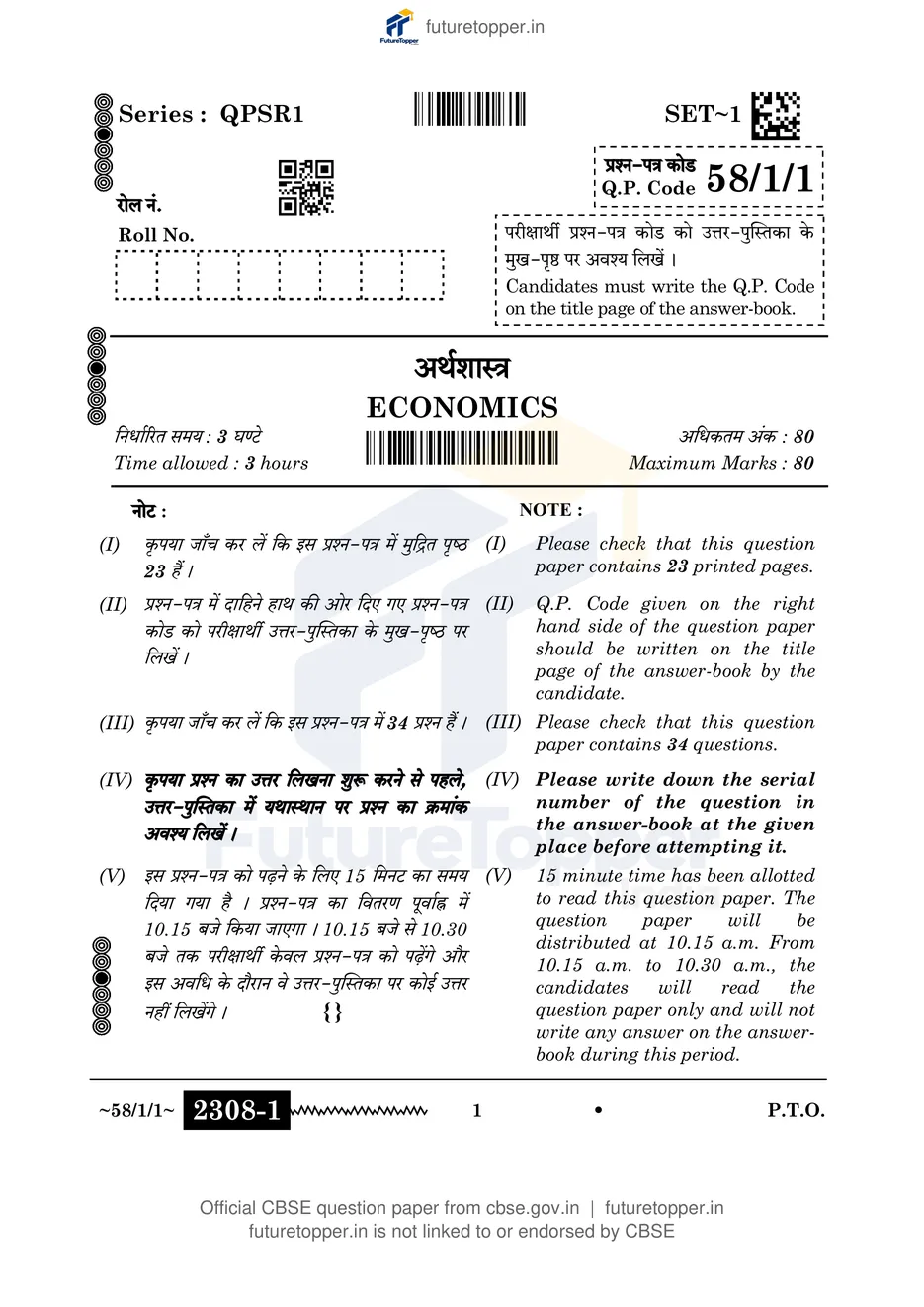
How to read a set code: 58/1/1 is Economics paper 58, group 1, set 1. Older and compartment papers use other groups or letters. Every set of a year follows the same pattern, so practise any one.
202618 papers
Class 12 Economics question paper 2026
Main exam
- Set 58/1/124 pages
- Set 58/1/224 pages
- Set 58/1/324 pages
- Set 58/2/124 pages
- Set 58/2/224 pages
- Set 58/2/324 pages
- Set 58/3/127 pages
- Set 58/3/227 pages
- Set 58/3/327 pages
- Set 58/4/127 pages
- Set 58/4/227 pages
- Set 58/4/327 pages
- Set 58/5/127 pages
- Set 58/5/227 pages
- Set 58/5/327 pages
Compartment exam
202521 papers
Class 12 Economics question paper 2025
Main exam
- Set 58/1/124 pages
- Set 58/1/224 pages
- Set 58/1/324 pages
- Set 58/2/124 pages
- Set 58/2/224 pages
- Set 58/2/324 pages
- Set 58/4/123 pages
- Set 58/4/223 pages
- Set 58/4/323 pages
- Set 58/5/127 pages
- Set 58/5/227 pages
- Set 58/5/327 pages
- Set 58/6/127 pages
- Set 58/6/227 pages
- Set 58/6/327 pages
- Set 58/7/123 pages
- Set 58/7/223 pages
- Set 58/7/323 pages
Compartment exam
202418 papers
Class 12 Economics question paper 2024
Main exam
- Set 58/1/127 pages
- Set 58/1/227 pages
- Set 58/1/327 pages
- Set 58/2/127 pages
- Set 58/2/227 pages
- Set 58/2/327 pages
- Set 58/3/127 pages
- Set 58/3/227 pages
- Set 58/3/327 pages
- Set 58/4/124 pages
- Set 58/4/224 pages
- Set 58/4/324 pages
- Set 58/5/124 pages
- Set 58/5/224 pages
- Set 58/5/324 pages
Compartment exam
202324 papers
Class 12 Economics question paper 2023
Main exam
- Set 58/1/127 pages
- Set 58/1/227 pages
- Set 58/1/327 pages
- Set 58/2/132 pages
- Set 58/2/232 pages
- Set 58/2/332 pages
- Set 58/3/131 pages
- Set 58/3/231 pages
- Set 58/3/331 pages
- Set 58/4/127 pages
- Set 58/4/227 pages
- Set 58/4/327 pages
- Set 58/5/124 pages
- Set 58/5/224 pages
- Set 58/5/324 pages
Compartment exam
Other versions (6): Punjabi, Urdu
202230 papers
Class 12 Economics question paper 2022
Main exam
- Set 58/1/112 pages
- Set 58/1/212 pages
- Set 58/1/312 pages
- Set 58/2/111 pages
- Set 58/2/211 pages
- Set 58/2/311 pages
- Set 58/3/112 pages
- Set 58/3/212 pages
- Set 58/3/312 pages
- Set 58/4/111 pages
- Set 58/4/211 pages
- Set 58/4/311 pages
- Set 58/5/112 pages
- Set 58/5/212 pages
- Set 58/5/312 pages
Compartment exam
Other versions (12): Punjabi, Urdu
- Set 226/2/1, Punjabi version, Main exam7 pages
- Set 226/2/2, Punjabi version, Main exam7 pages
- Set 226/2/3, Punjabi version, Main exam7 pages
- Set 251/5/1, Urdu version, Main exam8 pages
- Set 251/5/2, Urdu version, Main exam8 pages
- Set 251/5/3, Urdu version, Main exam8 pages
- Set 226/6/1, Punjabi version, Compartment exam7 pages
- Set 226/6/2, Punjabi version, Compartment exam7 pages
- Set 226/6/3, Punjabi version, Compartment exam7 pages
- Set 251/6/1, Urdu version, Compartment exam7 pages
- Set 251/6/2, Urdu version, Compartment exam7 pages
- Set 251/6/3, Urdu version, Compartment exam7 pages
202015 papers
Class 12 Economics question paper 2020
Main exam
20189 papers
Class 12 Economics question paper 2018
Main exam
201715 papers
Class 12 Economics question paper 2017
Main exam
- Set 58/1, Outside Delhi12 pages
- Set 58/1/1, Delhi16 pages
- Set 58/1/2, Delhi16 pages
- Set 58/1/3, Delhi16 pages
- Set 58/2, Outside Delhi12 pages
- Set 58/2/1, Foreign11 pages
- Set 58/2/2, Foreign11 pages
- Set 58/2/3, Foreign11 pages
- Set 58/3, Outside Delhi12 pages
Other versions (6): Punjabi, Urdu
- Set 226/1, Outside Delhi, Punjabi version, Main exam8 pages
- Set 226/2, Outside Delhi, Punjabi version, Main exam8 pages
- Set 226/3, Outside Delhi, Punjabi version, Main exam8 pages
- Set 251/1/1, Delhi, Urdu version, Main exam8 pages
- Set 251/1/2, Delhi, Urdu version, Main exam8 pages
- Set 251/1/3, Delhi, Urdu version, Main exam8 pages
20169 papers
CBSE's 2015 question paper page has only some subjects, and Economics is not one of them. CBSE's website has no Economics papers for 2019 and 2021.
Official CBSE question papers, downloaded from cbse.gov.in. The questions are CBSE's, unchanged. Future Topper is not linked to or endorsed by CBSE.
Class 12 Economics eBooks
BUY 2, GET 1 FREE
 Economics Sample Papers 2026-27₹69
 Economics Question Bank 2026-27₹49
 Economics Revision Capsule 2026-27Free
The Class 12 Economics paper at a glance
34 questions, 80 marks and 3 hours. The 2026 papers print 15 minutes of reading time before the 3 hours. The paper has two sections of 40 marks each: Macroeconomics and Indian Economic Development. The other 20 marks of Economics come from a project, so the subject is out of 100.
- Questions 1 to 17: 10 multiple choice questions of 1 mark, 2 short answers of 3 marks, 3 short answers of 4 marks and 2 long answers of 6 marks
- Questions 18 to 34: the same mix, 10 of 1 mark, 2 of 3 marks, 3 of 4 marks and 2 of 6 marks
There is no overall choice: you choose between two options inside a few questions. In CBSE's 2026-27 sample paper these are questions 11, 13 and 17 in Section A and 29, 32 and 33 in Section B. Board papers have sometimes put the choices in other questions, and the 2023 papers also had choices in some 1-mark questions. Keep to the word limits: 60 to 80 words for a 3-mark answer, 80 to 100 for 4 marks and 100 to 150 for 6 marks. This is the pattern of CBSE's 2026-27 sample paper (see our Class 12 Economics sample papers page), and CBSE says the design has not changed for 2026-27. The 2023, 2024, 2025 and 2026 board papers have the same pattern: two sections and 34 questions. CBSE's 2026-27 curriculum gives 40% of the marks (32) to remembering and understanding, 30% (24) to applying and 30% (24) to analysing, evaluating and creating.
Which chapters carry the most marks
Current Challenges facing Indian Economy carries the most: 20 of the 80 marks.
We went through 8 recent papers question by question, two sets from each year from 2023 to 2026. In 7 of the 8, every unit got exactly the marks in the table (we count steps against too much or too little demand under Determination of Income and Employment, as the curriculum does). In the other one, 2023 (58/1/1), Money and Banking got 7 and Balance of Payments 5, and in Section B, Development Experience and Reforms got 11 and Current Challenges 21. Inside a unit the marks move a lot: questions on employment carried 5 to 11 marks in a paper and questions on rural development 2 to 10. So no chapter is safe to skip.
- Current Challenges facing Indian Economy20Human capital formation; rural development; employment; sustainable economic development
- Determination of Income and Employment12Aggregate demand, propensity to consume and save, equilibrium output and the multiplier; excess and deficient demand
- Development Experience (1947-90) and Economic Reforms since 199112The economy on the eve of independence; Five Year Plans, agriculture, industry and foreign trade; liberalisation, globalisation and privatisation
- National Income and Related Aggregates10Basic concepts, circular flow, methods of calculating national income, GDP, GNP, NDP and NNP
- Development Experience of India: A Comparison with Neighbours8India and Pakistan; India and China
- Money and Banking6Money and money supply; money creation by banks; the central bank and its functions
- Government Budget and the Economy6Objectives and components of the budget; receipts and expenditure; budget deficits
- Balance of Payments6Balance of payments account; foreign exchange rate
Questions in all 8 recent papers
Thirteen kinds of question came in all 8 of those papers. The table shows the 8 that carried the most marks.
- Employment: types of workers, formal or informal sector, worker-population ratio, unemployment or jobless growth5 to 11 marks
- Planning from 1950 to 1990: plan goals, land reforms, green revolution, Industrial Policy Resolution 1956, licence raj or import substitution2 to 10 marks
- Rural development: rural credit, agricultural marketing, MSP, buffer stocks, diversification or organic farming2 to 10 marks
- Calculating national income: value added, income method or expenditure method3 to 9 marks
- Comparison of India with Pakistan or China: growth, population, sectors or reforms8 marks
- Consumption and saving: APC, MPC, APS, MPS, consumption function or saving function3 to 7 marks
- Human capital: education, health or training2 to 7 marks
- GDP and other aggregates: GNP, NDP, NNP, factor cost, real or nominal GDP, or GDP as a measure of welfare1 to 7 marks
Marks in one paper, adding up every question that included it; lowest and highest across the 8 papers. Five more came in all 8, for fewer marks: the government budget; environment or sustainable development; excess or deficient demand, or how to correct it; the balance of payments; and the foreign exchange rate. Three more came in 7 of 8 papers: the reforms since 1991; aggregate demand, equilibrium income or the investment multiplier; and the Indian economy under British rule. Questions on the RBI's functions and tools, asked under Money and Banking, came in 6 of 8 papers. Practise these until you can write them quickly. For more questions on them, see our Class 12 Economics eBooks.
Practise this year's pattern next
Past papers show what CBSE has asked before. For this year's pattern, practise with sample papers.
CBSE Class 12 Economics Sample Papers 2026-27
How to practise with these papers
Start with 2023, 2024, 2025 and 2026: they have the same pattern as your exam, 34 questions in two sections. The 2020 papers have the same sections and marks, but their 1-mark questions mix multiple choice with true or false, fill in the blank and one-line definitions. Papers from 2016 to 2018 (30 or 24 questions) and 2022 (13 questions for 40 marks in 2 hours) used older patterns. Use them for extra questions on a chapter, not as timed papers.
Write each paper in one sitting of 3 hours, book closed. Spend the first 15 minutes only reading: the 2026 papers print 15 minutes of reading time before the 3 hours.
Keep each answer within CBSE's word limit and draw the diagram or table when the question asks for one.
Check your answers against CBSE's marking scheme for that year. It gives marks for each part of an answer, so a correct part earns its marks even if the rest is wrong.
Note the units where you lost marks and revise them from the NCERT books CBSE prescribes, Macroeconomics and Indian Economic Development, before the next paper. The 2016 to 2018 papers also have a Microeconomics section, with questions on cost and production; Microeconomics is now part of Class 11.
Once the past papers are done, move to the Class 12 Economics sample papers for this year's pattern.
Keep the Class 12 Economics syllabus open while you practise, so you know what is still in the course.
Official CBSE sources
- CBSE question papers, 2022 to 2026 (opens in a new tab)
- CBSE marking schemes (answer keys), 2022 to 2026 (opens in a new tab)
- CBSE marking schemes 2016 (opens in a new tab)
- CBSE marking schemes 2017 (opens in a new tab)
- CBSE marking schemes 2018 (opens in a new tab)
- CBSE marking schemes 2020 (opens in a new tab)
- CBSE curriculum 2026-27, Economics (units, marks, project, question paper design) (opens in a new tab)
- CBSE sample question paper 2026-27, Economics (opens in a new tab)
- CBSE sample paper marking scheme 2026-27, Economics (opens in a new tab)
- CBSE date sheet for the 2027 board exams (opens in a new tab)
Frequently asked questions
Where can I download CBSE Class 12 Economics previous year question papers PDF?
On this page. Open the year, then tap a set: the paper opens in a new tab. Every set on CBSE's website for that year is listed. They are CBSE's own question papers, taken from cbse.gov.in.
Are answers available for these papers?
Yes. CBSE has published a marking scheme for 2016, 2017, 2018, 2020 and 2022 to 2026, and for the compartment exams of 2022 to 2026, with the answer to each question and the marks for each part. The links are in the official CBSE list at the bottom of this page.
Why are the 2015, 2019 and 2021 Economics papers missing?
CBSE's 2015 question paper page has only some subjects, and Economics is not one of them. CBSE's website has no Economics papers for 2019 and 2021.
What is the pattern of the CBSE Class 12 Economics paper for 2026-27?
34 questions for 80 marks in 3 hours, in two sections of 40 marks: Section A Macroeconomics and Section B Indian Economic Development. There are 20 multiple choice questions of 1 mark, 4 short answers of 3 marks, 6 short answers of 4 marks and 4 long answers of 6 marks.
Which years' papers match the 2026-27 pattern?
2023, 2024, 2025 and 2026: they have the same pattern: 34 questions in two sections. The 2020 papers also have 34 questions in the same two sections, but their 1-mark questions include true or false, fill in the blank and one-line definitions as well as multiple choice. Older papers had 30, 24 or 13 questions, so use them for extra practice on a chapter.
How many marks is Class 12 Economics out of?
100: the theory paper is 80 marks and the project 20. CBSE suggests marking the project as relevance of the topic 3, knowledge content and research work 6, presentation technique 3 and viva-voce 8.
Which chapters carry the most marks in Class 12 Economics?
Current Challenges facing Indian Economy carries the most, 20 of the 80 marks, across human capital, rural development, employment and sustainable development. Next come Determination of Income and Employment and Development Experience (1947-90) and Economic Reforms since 1991, with 12 each. National Income and Related Aggregates carries 10 and the comparison with neighbours 8. Money and Banking, Government Budget and the Economy and Balance of Payments carry 6 each. CBSE gives marks to units, not to single chapters.
Do questions repeat in the CBSE Class 12 Economics board exam?
Do not expect the same questions. The same kinds of question do come back: in the 8 papers from 2023 to 2026 that we went through, 13 kinds came every time. Among them: employment; rural development; planning from 1950 to 1990; calculating national income; consumption and saving; and the balance of payments.
How many previous year papers should I solve for Class 12 Economics?
There is no fixed number. A practical target is the last four years (2023 to 2026) as full timed papers, each one checked and its mistakes fixed before the next. Older papers are good for extra practice chapter by chapter.
What do codes like 58/1/1 mean, and why is the subject code 030?
58/1/1 means Economics paper 58, group 1, set 1; the last number is the set printed on the paper. 030 is the Economics subject code in the CBSE syllabus and on the date sheet, and 58 is the code printed on the question paper. Punjabi version papers carry 226 and Urdu version papers 251, as in 226/1/1. Some papers from 2016 to 2018 have only two numbers, such as 58/2: paper 58, set 2.
What do group and compartment mean?
The group is the middle number of the code, as the first 1 in 58/1/1. CBSE prints no rule for groups: each group is a different paper of the same pattern. Compartment papers are from what CBSE's question paper page calls the Compartment Examination: the later exam for students who need to clear a subject after the main exam.
Why do the 2016 to 2018 papers have questions on cost and production?
Those papers had a Microeconomics section, with questions on topics such as fixed cost and average and marginal product, and no Indian Economic Development section. In the 2026-27 curriculum, Microeconomics is part of Class 11 Economics; the Class 12 theory paper has Macroeconomics and Indian Economic Development only. Use the older papers' Macroeconomics questions for extra practice.
Were the 2022 Economics papers different?
Yes. The 2022 papers print "Time allowed: 2 hours" and "Maximum Marks: 40", with 13 questions: 5 of 2 marks, 5 of 3 marks and 3 of 5 marks. Use them for extra questions, not as a timed practice paper.
Is there a separate Hindi, Punjabi or Urdu medium Economics paper?
No separate Hindi paper is listed: the Economics papers we opened from 2023, 2025 and 2026 are printed in Hindi and English together. In the 2026 paper 58/1/1, for example, each page of questions in Hindi comes before the same questions in English. CBSE's website also has Punjabi version and Urdu version papers for 2017, 2018, 2022 and 2023, and this page lists them.
When is the CBSE Class 12 Economics exam in 2027?
Tuesday, 16 March 2027, from 10:30 am to 1:30 pm.