IBPS RRB PO vs IBPS RRB Clerk: A Detailed Comparison for Banking Aspirants
Sep 17
6 min read
Updated: Sep 18
For banking aspirants, IBPS RRB PO and IBPS RRB Clerk offer career opportunities in regional rural banking but differ in responsibilities, selection process, salary, and career growth. RRB PO is an officer-level role, while RRB Clerk focuses on daily banking operations and customer service. This article compares IBPS RRB PO vs RRB Clerk and highlights their key differences.
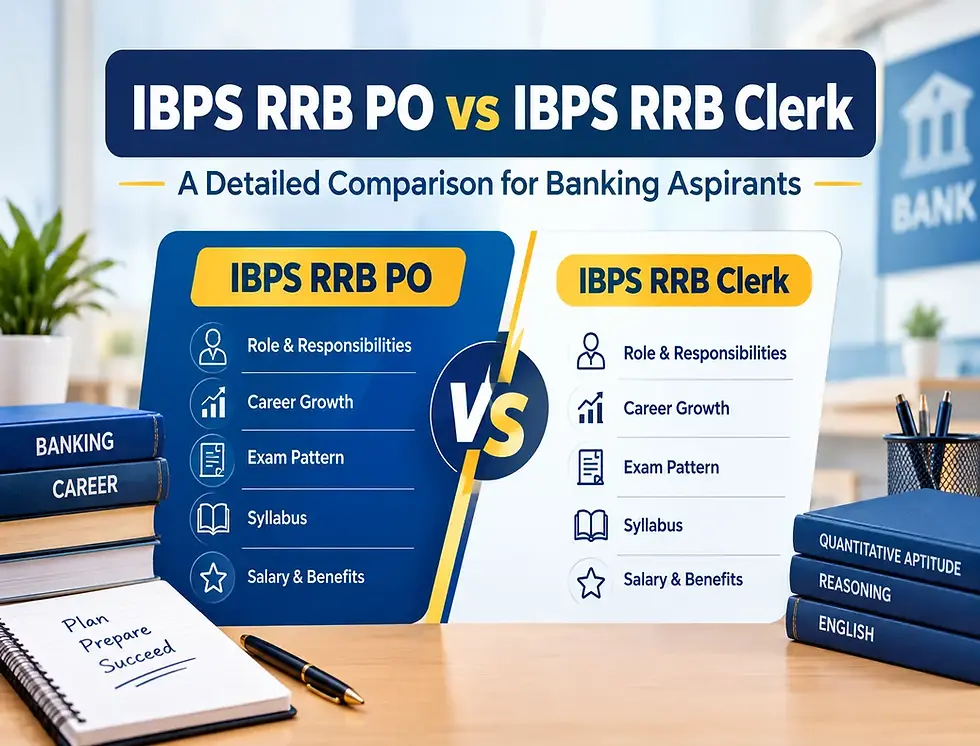
Understanding the Key Differences Between IBPS RRB PO and RRB Clerk
The key difference between IBPS RRB PO and RRB Clerk is their entry level and job responsibilities.
IBPS RRB PO (Officer Scale I): An officer-level role involving branch operations, administration, customer relationships, and banking management, with opportunities for career progression.
IBPS RRB Clerk (Office Assistant): A clerical role focused on daily banking operations, customer service, transactions, and documentation.
The selection process also differs: Officer Scale I includes Prelims, Mains, and Interview, while Office Assistant generally includes Prelims and Mains without an interview.
The following table provides a general comparison between the two positions.
Feature | IBPS RRB PO (Officer Scale I) | IBPS RRB Clerk (Office Assistant) |
Cadre | Officer-level | Clerical/Operational |
Primary Role | Banking operations, administration, and supervision | Customer service and daily banking support |
Selection Process | Prelims, Mains, Interview, & Local Language Proficiency Test | Prelims, Mains & Local Language Proficiency Test |
Interview | Yes | No |
Responsibility | Higher at the entry level | Mainly operational |
Career Path | Officer and managerial progression | Internal promotion opportunities |
Starting Basic Pay | ₹48,480 / month | ₹26,730 / month |
Approximate In-Hand Salary | ₹74,561 / month | ₹43,713 / month |
Salary and service conditions may vary based on rules, allowances, deductions, and posting location.
Differences in the Selection Process
A major difference between IBPS RRB PO and RRB Clerk is their selection process.
IBPS RRB PO Selection Process
Candidates applying for Officer Scale I generally go through these stages:
Preliminary Examination
Main Examination
Interview
Local Language Proficiency Test
The interview is an additional stage, requiring preparation beyond the written exams.
IBPS RRB Clerk Selection Process
The office assistant selection process generally includes:
Preliminary Examination
Main Examination
Local Language Proficiency Test
Unlike Officer Scale I, the Office Assistant process has no interview stage.
IBPS RRB PO vs RRB Clerk Exam Pattern and Difficulty
The IBPS RRB PO and RRB Clerk exams cover similar subjects, but their difficulty and preparation approach may differ. Both prelims focus on reasoning ability and quantitative/numerical ability, with no separate English or Hindi section. Candidates should focus on speed and accuracy to manage the limited exam time effectively.
Preliminary Examination: Speed and Analytical Ability
The nature of the questions can differ between the two examinations.
IBPS RRB Clerk Preliminary Examination
The RRB Clerk exam emphasises speed and accuracy, requiring candidates to solve questions efficiently within the given time. The reasoning section may include puzzles and seating arrangements, while numerical ability covers:
Simplification and Approximation
Number Series
Basic Arithmetic
Data Interpretation
Other Numerical Ability topics
Candidates should focus on quick calculations and avoid spending too much time on difficult questions.
IBPS RRB PO Preliminary Examination
The IBPS RRB PO exam may include more analytical questions, particularly in the reasoning and quantitative sections. Candidates may encounter complex puzzles, multiple-variable arrangements, and challenging data interpretation sets. Preparation should focus on both speed and logical understanding.
Main Examination Pattern
The main examination is a crucial stage for both IBPS RRB PO and RRB Clerk candidates.
IBPS RRB Clerk Mains Examination
As per the examination pattern, the Mains exam includes the following sections:
Section | Number of Questions | Marks | Duration |
Reasoning | 40 | 50 | 30 minutes |
Computer Knowledge | 40 | 20 | 15 minutes |
General Awareness | 40 | 40 | 15 minutes |
English / Hindi | 40 | 40 | 30 minutes |
Numerical Ability | 40 | 50 | 30 minutes |
Total | 200 | 200 | 120 minutes |
The exam assesses candidates in Reasoning, Numerical Ability, Computer Knowledge, General Awareness, and Language Proficiency.
IBPS RRB PO Mains Examination
The provided pattern for the IBPS RRB PO Mains examination is as follows:
Section | Number of Questions | Marks | Duration |
Reasoning | 40 | 50 | 30 minutes |
General Awareness | 40 | 40 | 15 minutes |
Quantitative Aptitude | 40 | 50 | 30 minutes |
English/Hindi Language | 40 | 40 | 30 minutes |
Computer Knowledge | 40 | 20 | 15 minutes |
Total | 200 | 200 | 120 minutes |
The subjects largely overlap with the Clerk examination, but the difficulty and analytical level of questions may vary.
IBPS RRB PO vs RRB Clerk: Salary, Job Profile and Career Growth
Salary is a key factor, but candidates should also consider job responsibilities and career growth.
Salary Comparison
Salary is a key difference between the IBPS RRB PO and RRB Clerk roles.
IBPS RRB PO Salary
An IBPS RRB Officer Scale I employee has a starting basic pay of ₹48,480 per month, including applicable:
Dearness Allowance
House Rent Allowance
Special Allowances
Other benefits
The approximate in-hand salary is ₹74,561 per month, though the actual amount may vary based on deductions, allowances, and posting location.
IBPS RRB Clerk Salary
An IBPS RRB office assistant has a starting basic pay of ₹26,730 per month. The salary may include applicable allowances, while NPS and professional tax can affect the final amount.
The approximate in-hand salary is ₹43,713 per month, though it may vary based on deductions and other applicable factors.
Job Responsibilities and Work Environment
Understanding the actual work involved is essential before choosing either position.
IBPS RRB PO Job Profile
An Officer Scale I employee may handle branch-level responsibilities, including:
Managing banking operations
Supervising branch activities
Handling administrative tasks
Managing customer relationships
Supporting loan and credit activities
Assisting in decision-making
The role involves greater responsibility and exposure to banking management.
IBPS RRB Clerk Job Profile
The office assistant role mainly supports daily banking operations, including:
Assisting customers and handling queries
Supporting banking transactions
Managing documentation
Performing clerical tasks
Supporting branch operations
The role offers practical banking experience with regular customer interaction.
Career Growth and Promotion Opportunities
Both positions offer long-term career opportunities in regional rural banking, but their starting levels and promotion paths differ.
IBPS RRB PO Career Growth
An IBPS RRB Officer Scale I employee starts at the officer level and can progress based on performance, experience, and promotion policies.
The career path may include:
Officer Scale I
Assistant Manager
Deputy Manager
Branch Manager
Senior Branch Manager
Chief Manager
Assistant General Manager
Deputy General Manager
General Manager
Career progression depends on performance and applicable promotion procedures.
IBPS RRB Clerk Career Growth
An IBPS RRB clerk starts as an office assistant and gains experience in banking operations.
The career progression may include:
Office Assistant / Clerk
Officer Scale I
Assistant Manager
Deputy Manager
Branch Manager
Senior Branch Manager
Chief Manager
Assistant General Manager
Deputy General Manager
General Manager
Eligible employees can progress through internal promotion processes, with the timeline and criteria depending on the respective Regional Rural Bank’s policies.
IBPS RRB PO vs RRB Clerk: Which Role Is More Suitable for You?
Choosing between IBPS RRB PO and IBPS RRB Clerk depends on an aspirant’s career goals, preferred responsibilities, and career expectations.
IBPS RRB PO May Be Suitable for Aspirants Who:
Want an officer-level career.
Are comfortable with greater responsibility.
Prefer branch management and supervision.
Seek higher salary and career growth.
Are prepared for the interview stage.
Prefer managerial and administrative roles.
It may suit aspirants aiming for managerial and senior banking roles.
IBPS RRB Clerk May Be Suitable for Aspirants Who:
Prefer a clerical or operational role.
Are comfortable with customer service and daily banking.
Prefer written exams without an interview.
Want lower managerial responsibilities initially.
Seek practical experience in banking operations.
It can suit candidates seeking to enter banking and gain experience in branch operations.
How Aspirants Can Prepare for Both Examinations
Since IBPS RRB PO and RRB Clerk share a considerable syllabus, aspirants can prepare for both exams together.
1) Focus on Common Subjects
Reasoning and Quantitative/ Numerical ability are important in both exams. Identify common topics and practise them systematically.
2) Prepare for the Higher Difficulty Level
Practise selected topics at the PO difficulty level to strengthen problem-solving skills while maintaining the speed needed for the Clerk exam.
3) Develop Time Management Skills
Use mock tests and timed practice to:
Identify easy questions quickly
Avoid time-consuming problems
Maintain accuracy
Review performance
4) Strengthen General and Computer Awareness
General Awareness and Computer Knowledge are part of the Mains exam. Regular practice and revision can improve performance.
5) Understand Local Language Requirements
Review the official recruitment notification for local language requirements in your chosen region.
Conclusion
IBPS RRB PO and IBPS RRB Clerk offer different banking career paths. The right choice depends on your career goals and preferred responsibilities.
Note: Exam patterns, eligibility, and salary may change. Check the latest official IBPS notification for updates.
Frequently Asked Questions on IBPS RRB PO vs RRB Clerk
Q1. Is there an interview for IBPS RRB Clerk?
No. IBPS RRB Clerk has no interview. Final selection depends on the written exams and other requirements in the official notification.
Q2. Is there an English section in IBPS RRB PO and Clerk Prelims?
No. The prelims mainly cover reasoning ability and quantitative/numerical ability. Candidates should check the latest official notification for the updated pattern.
Q3. Can an IBPS RRB Clerk become a PO?
Yes. Eligible office assistants can progress to Officer Scale I through internal promotion, based on the RRB’s policies.
Q4. Which exam is more difficult: IBPS RRB PO or RRB Clerk?
IBPS RRB PO may involve higher-level questions and an interview, while RRB Clerk focuses more on speed and accuracy.
Q5. Which role offers a higher salary: IBPS RRB PO or RRB Clerk?
IBPS RRB PO generally offers a higher salary, though in-hand pay varies with allowances and deductions.
Q6. Should I prepare for both IBPS RRB PO and RRB Clerk?
Yes. Both exams share considerable syllabus overlap, so candidates can prepare for them together while considering their difficulty and selection differences.