Why Maths Confidence Drops When Students Memorise Instead of Understanding
Sep 21
6 min read
Mathematics is one of the subjects where students often appear confident at first, then suddenly begin to struggle.
In lower secondary school, a student may do reasonably well by following examples, memorising formulas, and practicing common question types. But as the topics become harder, this approach may stop working. The student may still be putting in effort, but the results do not improve.
This can be frustrating for both students and parents. The child may say, “I studied already,” but the marks remain inconsistent. Parents may wonder whether the student is careless, lazy, or simply not suited for maths.
Very often, the real issue is not effort. It is the way the student is learning.
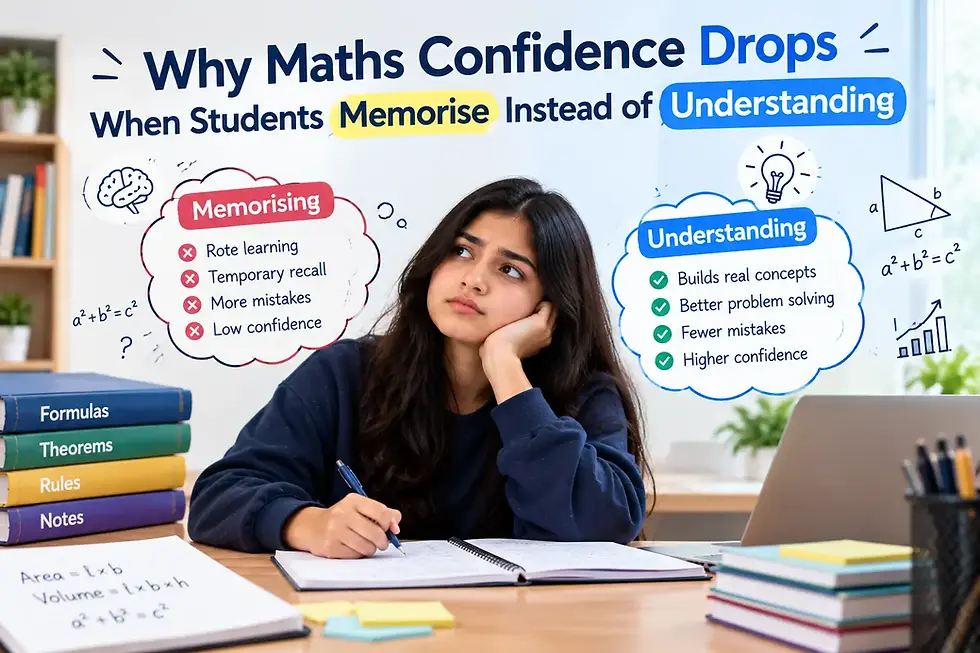
When students rely too heavily on memorisation, their maths confidence becomes fragile. The moment a question looks unfamiliar, they panic. To build lasting confidence, students need to understand the concepts behind the methods.
Why Memorisation Feels Easier at First
Memorisation feels efficient because it gives students quick results.
If a teacher shows a method and students practise ten similar questions, they may feel that they have mastered the topic. They remember the steps and repeat them successfully.
This works for simple or familiar questions. But maths becomes harder when questions are combined, reworded, or presented in real-world contexts.
For example, a student may memorise a formula for speed, distance, and time. But when the question involves two people travelling at different speeds, with one starting later than the other, memorisation alone may not be enough.
The student must understand what the formula means and how the quantities relate to one another.
This is why confidence drops. Students thought they understood the topic, but they had actually memorised a pattern.
Secondary Math’s Requires Deeper Thinking
Secondary maths introduces students to more abstract and connected topics. Algebra becomes more important. Graphs become more detailed. Geometry requires clearer reasoning. Word problems may involve more steps. Statistics and probability require interpretation, not just calculation.
MOE’s guidance on the transition to secondary school notes that students will face changes such as more subject choices and a new learning environment. Academically, many students also experience a shift in expectations. They are expected to be more independent and to handle more complex tasks.
In maths, this means students cannot rely only on copying methods. They must learn to ask why a method works.
For instance, solving an equation is not just about moving numbers across the equal sign. Students need to understand balance. Expanding brackets is not just a mechanical step. It is based on distributive law. Graphs are not just drawings. They represent relationships between variables.
When students understand these ideas, they become more adaptable.
The Danger of Practising Without Understanding
Practice is important in maths, but practice without understanding can become unproductive.
A student may complete many worksheets but repeat the same mistakes. Another may memorise model solutions without being able to solve a slightly different question. Some students even become dependent on recognising question patterns.
This creates a false sense of security.
During homework, the student may do well because the questions follow the lesson closely. But during tests or exams, where questions are mixed and less predictable, the student struggles.
This is why parents should not only ask, “Did you finish your practice?” A better question is, “Can you explain how you solved it?”
If a student can explain the reasoning clearly, they probably understand the topic. If they can only say, “This is the method my teacher gave,” they may need more conceptual support.
Maths Confidence Comes From Knowing What to Do When Stuck
A confident maths student is not someone who always knows the answer immediately. A confident student is someone who knows how to begin.
When faced with a difficult question, they can identify the topic, write down what is given, recall relevant concepts, and try a logical first step.
Students who rely on memorisation often do not have this flexibility. If the question does not look like something they have seen before, they freeze.
This is why building problem-solving habits is so important.
Students should learn to ask what information is given, what is unknown, whether a diagram can help, whether an equation can be formed, and which concept is being tested.
These questions help students slow down and think. Instead of panicking, they begin to break the problem into smaller parts.
Foundations Matter More Than Students Realize
Many secondary maths struggles begin with weak foundations.
Algebra is one of the most common examples. If a student is weak in algebra, many topics become harder: equations, graphs, inequalities, functions, and word problems.
Fractions are another common issue. Students who are uncomfortable with fractions may make mistakes in ratios, algebraic fractions, probability, and indices.
Geometry also requires a strong foundation. If students do not understand angle properties clearly, they may struggle with more advanced geometry questions later.
This is why tuition, revision, or extra practice should not always focus only on the current school topic. Sometimes, students need to go back and repair earlier gaps.
Targeted support such as secondary maths tuition can help students identify weak areas, rebuild foundations, and learn how to approach maths with better understanding rather than memorising isolated methods.
Exam Preparation Should Not Be Last-Minute
Many students only start serious maths revision near exam season. By then, they may feel overwhelmed because maths cannot be memorised quickly like a list of facts.
Maths improvement takes time. Students need repeated exposure to concepts, different question types, and proper correction.
A better approach is to revise consistently. Short, regular sessions are usually more effective than long, stressful sessions before exams.
For example, a student can spend one day reviewing algebra, another day practising graphs, and another day correcting past mistakes. This keeps topics fresh and reduces panic before tests.
The official SEAB page for the GCE O-Level provides a useful reference point for students and parents who want to understand the broader national examination framework. While lower secondary students may not be taking O-Levels yet, the habits they build early will affect how prepared they are later.
Parents Should Focus on Process, Not Just Marks
When a child performs poorly in maths, it is natural for parents to focus on the score. But marks alone do not explain the problem.
A student may lose marks because of careless mistakes, poor time management, weak concepts, messy working, or misunderstanding the question. Each problem requires a different solution.
Parents can help by reviewing the process. Ask the child to go through the paper and identify the type of mistakes made.
For example, did they understand the question, choose the correct method, make careless calculation errors, skip steps, run out of time, forget a formula, or misunderstand a concept?
This kind of review helps students see mistakes as fixable. It also prevents them from thinking, “I am just bad at maths.”
How Students Can Move From Memorising to Understanding
To improve maths understanding, students should change how they revise.
First, they should study examples actively. Instead of copying the solution, they should ask why each step is done.
Second, they should practise explaining concepts in their own words. If they can teach the idea to someone else, they likely understand it.
Third, they should attempt mixed-topic questions. These train students to recognise concepts without being told which chapter the question comes from.
Fourth, they should correct mistakes properly. Reading the answer key is not enough. Students should redo the question without looking at the solution.
Finally, they should build confidence through gradual progress. Start with foundation questions, then move to intermediate questions, then attempt harder ones. Jumping straight into difficult questions can be discouraging if the basics are weak.
Conclusion
Maths confidence does not come from memorising more steps. It comes from understanding what those steps mean.
Students who rely only on memory may do well when questions are familiar, but they often struggle when questions change. Students who understand concepts can adapt, reason, and solve problems more calmly.
For secondary students, this difference matters. Maths topics become more connected as students progress through school. Weak foundations and shallow memorisation can make the subject feel harder each year.
The solution is not simply to practise more, but to practise better. Students need to review mistakes, strengthen foundations, ask why methods work, and learn how to approach unfamiliar problems.
With the right mindset and support, students can rebuild their confidence. Maths becomes less about guessing the correct formula and more about thinking clearly, step by step.